Supracondylar process (Latin: processus supracondylaris humeri)
Also called the supra-epicondylar process
What is the supracondylar process?
· It is an uncommon variant, not a normal feature of the humerus.
· It may be joined to the medial epicondyle by a fibrous band, the ligament of Struthers; some fibres of the pronator teres arise from this ligament (or from the process).
· The median nerve and the brachial artery may pass under the ligament, through the tunnel it closes; compression here may imitate other median nerve entrapments.
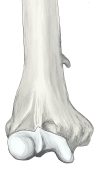 Lower end of right humerus (anterior view)
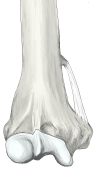 Ligament of Struthers
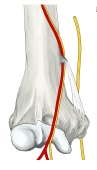 Median nerve and brachial artery under the ligament
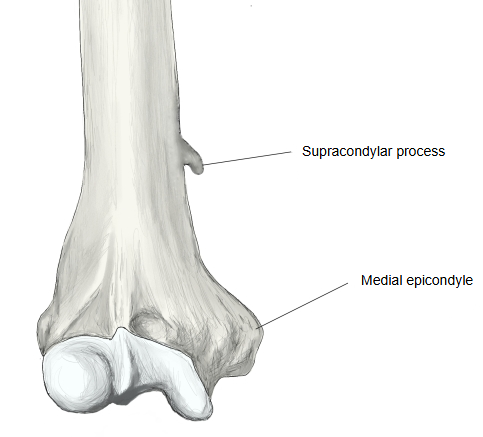
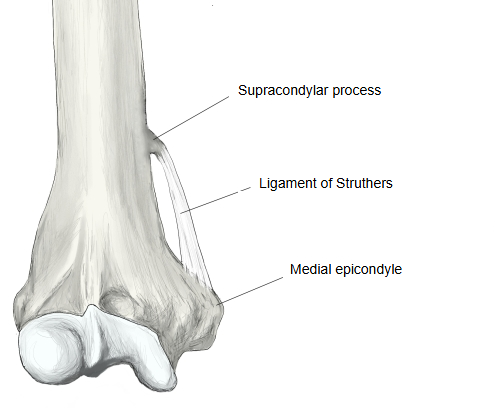
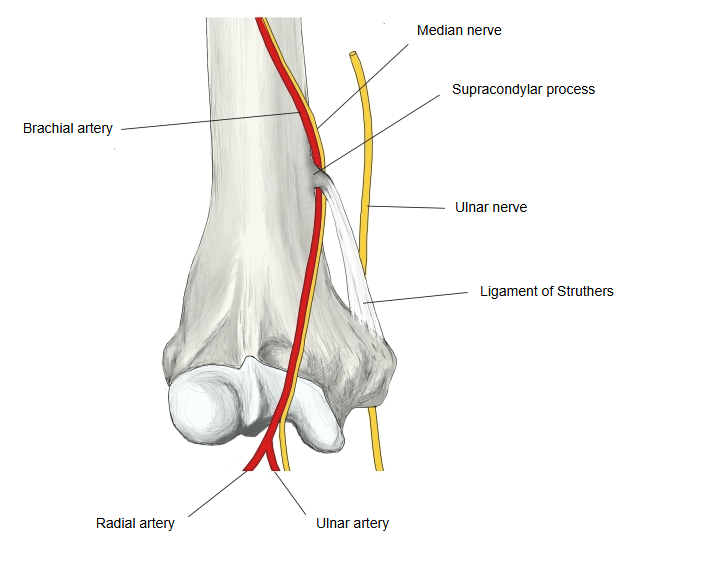
· It is usually harmless and is often found by chance on an X-ray of the arm. It should not be confused with the medial and lateral supracondylar ridges, which are normal edges of the lower end of the humerus.
The supracondylar process of the humerus is a small, hook-shaped bony projection on the front and medial side of the lower part of the shaft of the humerus, a few centimetres above the medial epicondyle. It points downwards, forwards and medially, towards the medial epicondyle. It is an anatomical variation, present in only a small proportion of people (sources differ on the rate). A fibrous band, the ligament of Struthers, may join its tip to the medial epicondyle.
Reference websites
[Wikipedia]
· Supracondylar process of the humerus, Wikipedia.
· Ligament of Struthers, Wikipedia.
Where it is found
Related terms
- Medial epicondyle
- Medial supracondylar ridge
- Lateral supracondylar ridge
- Shaft of humerus
- Lower end of humerus
- Supratrochlear foramen
- Humerus
References and sources
- Further reading: Supracondylar process of the humerus, Wikipedia.
- Further reading: Ligament of Struthers, Wikipedia.
- Federative International Programme for Anatomical Terminology (FIPAT). Terminologia Anatomica, 2nd ed. (TA2), 2019.