Latin: organum gustatorium
Overview
- The organ of taste: the taste buds, small clusters of receptor cells in the epithelium of the mouth and throat.
- Most lie on the tongue, in the walls of the vallate and foliate papillae and on the fungiform papillae; a few are in the soft palate, pharynx and epiglottis.
- The receptor cells are the gustatory cells; they detect sweet, salty, sour, bitter and umami.
- The tongue as an organ is described in Splanchnology (Tongue).
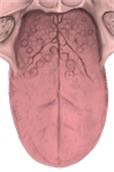
Dorsum of the tongue 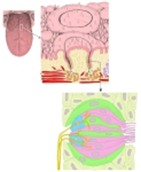
Taste bud in a vallate papilla
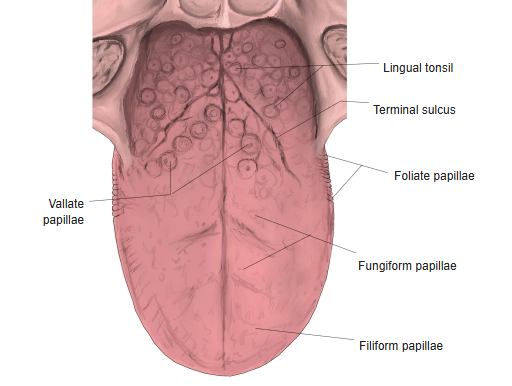
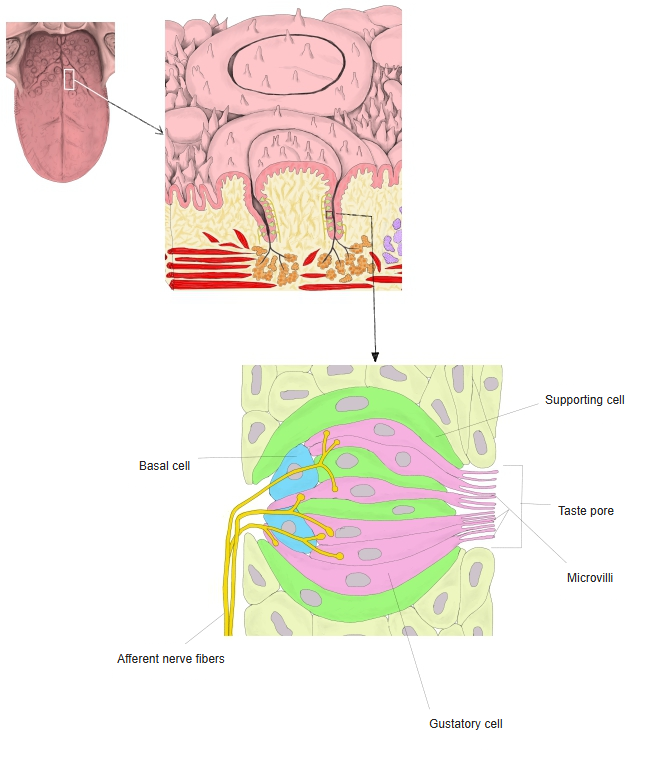
Parts of the gustatory organ
Nerves of taste
| Region | Nerve |
|---|---|
| Anterior two-thirds of the tongue (fungiform papillae) | Chorda tympani of the facial nerve (CN VII), via the lingual nerve |
| Soft palate | Greater petrosal nerve (facial nerve) |
| Posterior third of the tongue (vallate and foliate papillae) | Glossopharyngeal nerve (CN IX) |
| Epiglottis and nearby pharynx | Vagus nerve (CN X) |
- All taste fibers end in the nucleus of the solitary tract in the medulla oblongata.
- Smell contributes much of what is perceived as the "flavour" of food.
References and sources
- Further reading: Gustatory organ, Wikipedia.