Latin: glandula lacrimalis
Overview
- The tear-producing gland, about the size of an almond, in the fossa for the lacrimal gland of the frontal bone, at the upper lateral part of the orbit.
- The tendon of the levator palpebrae superioris divides it into a larger orbital part and a smaller palpebral part.
- A serous gland; about 6–12 small ducts open into the lateral part of the superior conjunctival fornix.
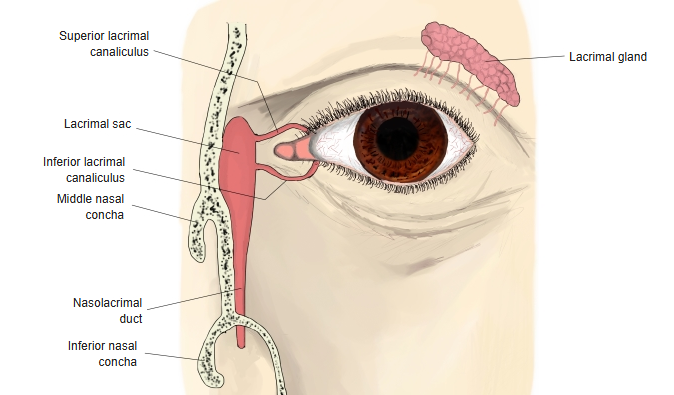
- Tears flow across the eye and are drained by the rest of the lacrimal apparatus.
Lacrimal apparatus
Vessels and nerves
- Artery: the lacrimal artery, a branch of the ophthalmic artery; vein: the lacrimal vein to the superior ophthalmic vein.
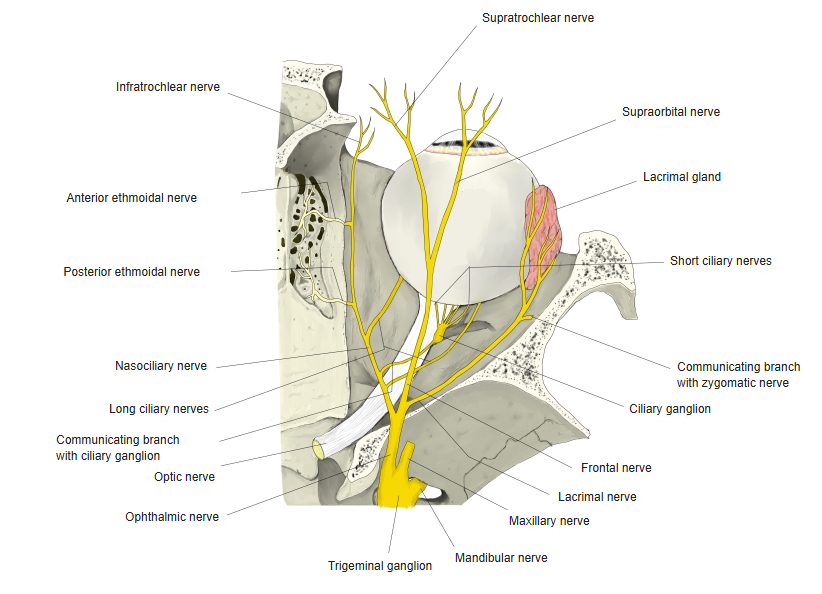
- Secretory (parasympathetic) fibres: from the facial nerve via the greater petrosal nerve and the pterygopalatine ganglion; they reach the gland through the zygomatic nerve and its communicating branch with the lacrimal nerve.
- Sensory fibres: the lacrimal nerve (ophthalmic nerve).
- Sympathetic fibres come with the blood vessels.
Lacrimal gland and nerves of the orbit
References and sources
- Further reading: Lacrimal gland, Wikipedia.