Latin: Venae emissariae
Overview
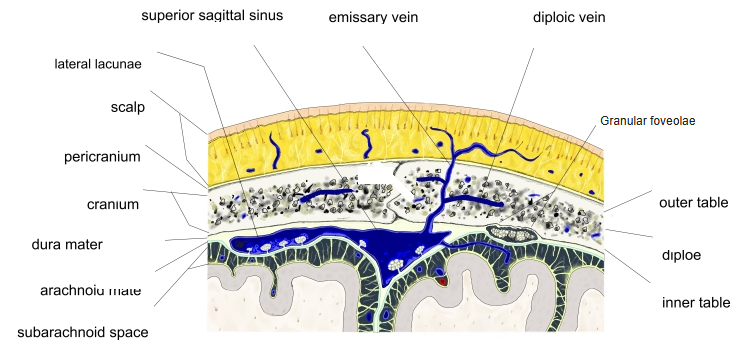
- Small valveless veins that pass through openings in the skull and connect the dural venous sinuses with the veins outside the skull.
- Blood can flow in either direction, helping to balance pressure inside the skull.
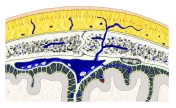
Layers of the scalp and skull 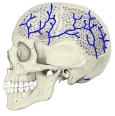
Diploic and emissary veins
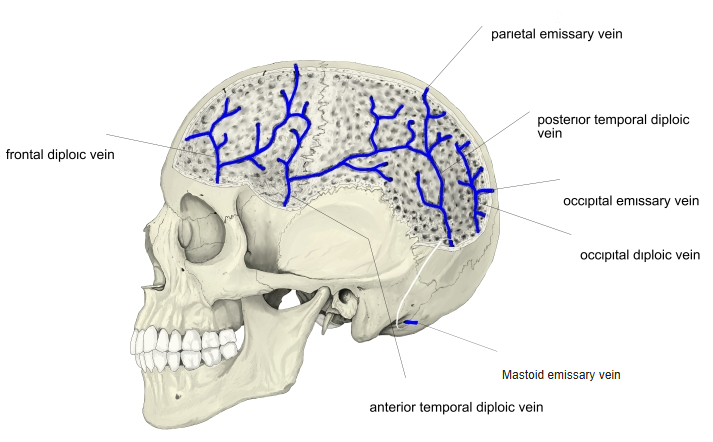
Main emissary veins
| Emissary vein | Opening | Connects |
|---|---|---|
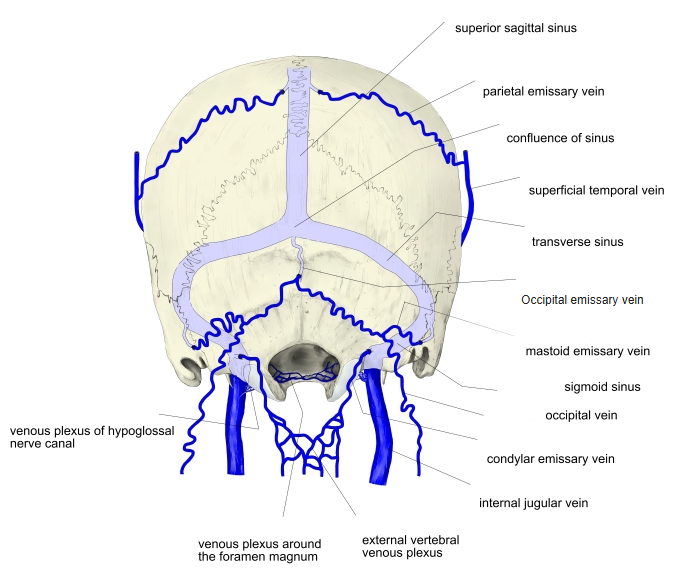
| Parietal emissary vein | Parietal foramen | Superior sagittal sinus ↔ veins of the scalp |
| Mastoid emissary vein | Mastoid foramen | Sigmoid sinus ↔ occipital / posterior auricular vein |
| Condylar emissary vein | Condylar canal | Sigmoid sinus ↔ suboccipital plexus |
| Occipital emissary vein | Occipital protuberance region | Confluence of sinuses ↔ occipital vein |
| Venous plexus of hypoglossal canal | Hypoglossal canal | Sigmoid sinus ↔ internal jugular vein |
| Venous plexus of foramen ovale | Foramen ovale | Cavernous sinus ↔ pterygoid plexus |
| Emissary vein of foramen lacerum | Foramen lacerum | Cavernous sinus ↔ pterygoid / pharyngeal plexus |
| Internal carotid venous plexus | Carotid canal | Cavernous sinus ↔ internal jugular vein |
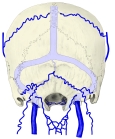
Emissary veins of the back of the skull
Clinical notes
- Emissary veins are a route for infection from the scalp or face to reach the venous sinuses (for example cavernous sinus thrombosis from facial infections).
- A large mastoid emissary vein can bleed during ear or skull-base surgery.
References and sources
- Further reading: Emissary veins, Wikipedia.