Carina (Latin: carina tracheae)
Also called Carina of trachea or the tracheal carina
Reference websites
[Wikipedia]
· Carina of trachea, Wikipedia.
[Websites with illustrations]
· Trachea (ClipArt ETC (University of South Florida))

· Trachea and bronchi (illustration) (IMAIOS e-Anatomy)
· The carina usually lies at about the level of the 4th to 5th thoracic vertebrae (the level of the sternal angle), but its position moves up and down with breathing.
· It lies slightly to the left of the midline and runs from front to back.
· It receives its blood supply from the bronchial arteries.
· Its mucosa is very sensitive, and touching it causes coughing. On bronchoscopy, a widened or blunted carina may point to enlarged lymph nodes below it. Just above this level, the aortic arch passes over the left main bronchus and the azygos vein arches over the right main bronchus.
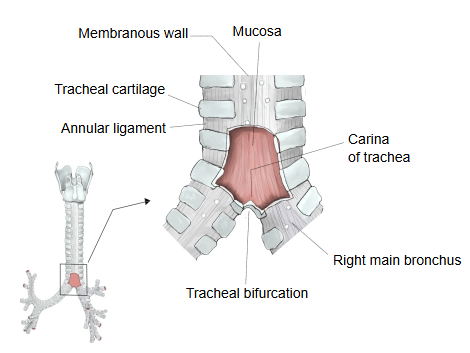
Where it is found
Related terms
References and sources
- Further reading: Carina of trachea, Wikipedia.
- Federative International Programme for Anatomical Terminology (FIPAT). Terminologia Anatomica, 2nd ed. (TA2), 2019.