Mesorectum (Latin: mesorectum)
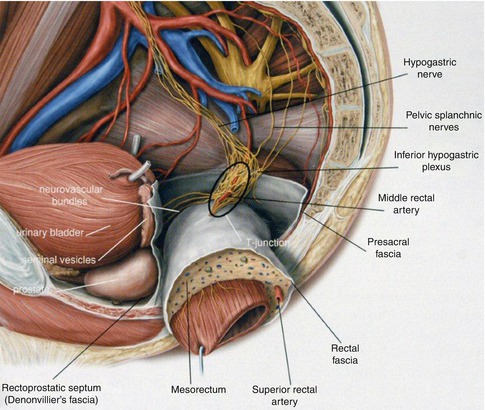
· The mesorectum is the thick layer of fatty tissue that wraps the back and both sides of the rectum. It contains the vessels running to the rectum (branches of the superior rectal artery and the superior rectal vein), the lymph vessels and lymph nodes that drain the rectum, and autonomic nerve fibres.
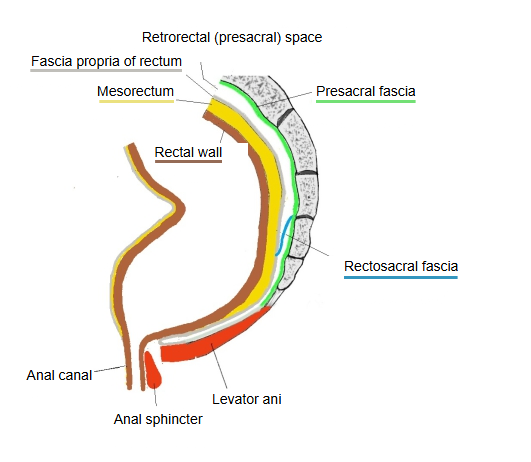
· Despite the name, it is not a thin, double fold of peritoneum like a mesentery but a thick, bulky cuff of fat. On the outside it is wrapped by a thin membrane, the "fascia propria of the rectum" (mesorectal fascia).
Where it begins
· It appears clearly where the sigmoid colon becomes the rectum, in front of the upper sacrum (about the level of the third sacral vertebra).
· In the sigmoid colon, the sigmoid mesocolon, which ties the bowel to the posterior abdominal wall, is a thin membrane of two layers of peritoneum with vessels and fat between them, and the fat lies only behind the bowel. Where the rectum begins, this fat spreads round to the sides as well and wraps the rectum; covered on the outside by the fascia propria of the rectum, it becomes one mass, the mesorectum.
· The mesorectum is thick behind and at the sides, but very thin in front (in places almost absent). Lower down it tapers out toward the pelvic floor near the levator ani.
Behind it, the retrorectal (presacral) space separates the fascia propria from the presacral fascia on the front of the sacrum; lower down, the rectosacral fascia crosses this space from the sacrum to the back of the fascia propria. Mesorectum is mainly a surgical term, and sources differ on how far it extends round the front of the rectum and on whether the rectosacral fascia is a separate layer.
How it differs from other mesenteries
· Shape: an ordinary mesentery (such as the mesentery of the small intestine or the sigmoid mesocolon) is a thin sheet that hangs an organ from the posterior abdominal wall, so the bowel can move fairly freely. The mesorectum, by contrast, is a three-dimensional mass of fat that wraps the rectum.
· Function: in the narrow pelvis it supports the rectum and acts as a cushion.
· Covering: an ordinary mesentery is covered by peritoneum on both faces, whereas most of the mesorectum lies below (outside) the peritoneum and is wrapped by a fibrous membrane, the fascia propria of the rectum; only its upper part is covered by peritoneum.
Clinical significance
· Rectal cancer often spreads first to the lymph nodes inside the mesorectum.
· In 1982 the British surgeon R. J. Heald introduced total mesorectal excision (TME): the mesorectum is removed in one piece, without damage, inside an intact fascia propria of the rectum. It greatly reduced local recurrence of rectal cancer and is now the standard approach in rectal cancer surgery.
· The layer dissected is the loose areolar plane between the fascia propria of the rectum and the presacral fascia, often called the "holy plane". The pelvic autonomic nerves lie just outside this plane, so keeping to it helps preserve bladder and sexual function.
More details
· See "Fascia propria of rectum", "Sigmoid mesocolon", "Presacral fascia" and "Mesentery".
Reference websites
[Wikipedia]
· Mesentery, Wikipedia.
· Total mesorectal excision, Wikipedia.
[Websites with illustrations]
· Mesorectum and mesorectal fascia (cross-section) (Springer)

· Mesorectum in the pelvis, with the presacral space and nerves (Springer)

· Mesorectum, rectal fascia and pelvic nerves (Abdominal Key)
Where it is found
Related terms
References and sources
- Further reading: Mesentery, Wikipedia.
- Further reading: Total mesorectal excision, Wikipedia.
- Federative International Programme for Anatomical Terminology (FIPAT). Terminologia Anatomica, 2nd ed. (TA2), 2019.