Sigmoid mesocolon (Latin: mesocolon sigmoideum)
- Overview
- Structures passing through it
- Reference websites
- (Wikipedia, websites with illustrations)
- Related terms
Overview
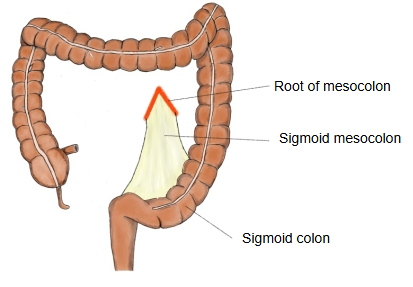
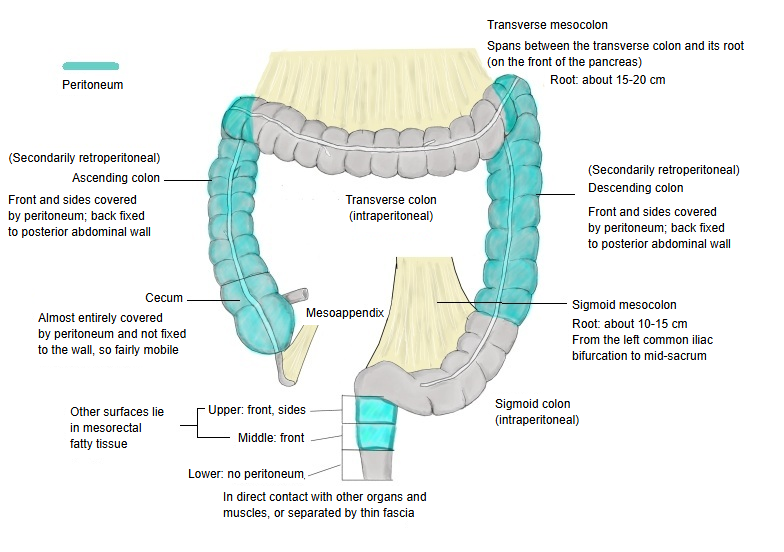
· From its root it fans out downward so that it covers the whole length of the sigmoid colon; the sigmoid colon is therefore intraperitoneal and fairly mobile.
· Its root is attached to the posterior wall in the shape of an inverted V near the left pelvic inlet: one limb runs up along the left external iliac vessels, the other runs down from near the bifurcation of the left common iliac artery to the front of the sacrum (about the third sacral vertebra).
· The root is roughly 10–15 cm long, and the left ureter lies behind its apex. The length of the mesocolon itself varies widely; a long one lets the sigmoid colon twist on itself (sigmoid volvulus).
The figure below shows how each part of the large intestine (colon) is related to the peritoneum.
Structures passing through it
Blood vessels: the sigmoid arteries, branches of the inferior mesenteric artery, run through it and bring blood to the intestine; the sigmoid veins run with them, and the superior rectal vessels run in its root.
Nerves: sympathetic fibres from the lumbar splanchnic nerves (via the inferior mesenteric plexus); parasympathetic fibres from the pelvic splanchnic nerves.
Lymphatic vessels and nodes: the sigmoid lymph nodes, which drain to the inferior mesenteric lymph nodes.
Reference websites
[Wikipedia]
· Sigmoid colon, Wikipedia.
· Mesentery (includes the sigmoid mesocolon), Wikipedia.
[Websites with illustrations]
· Colon with the transverse and sigmoid mesocolon (figure) (Basicmedical Key)

· Large intestine and mesocolon (figure) (Science Photo Library)
Related terms
- Transverse mesocolon
- Mesentery
- Colon
- Peritoneum
- Intraperitoneal organs
- Sigmoid arteries
- Sigmoid veins
References and sources
- Further reading: Sigmoid colon, Wikipedia.
- Further reading: Mesocolon, Wikipedia.
- Federative International Programme for Anatomical Terminology (FIPAT). Terminologia Anatomica, 2nd ed. (TA2), 2019.