Pyloric part (Latin: pars pylorica)
Also called the pyloric region
· The pyloric part is the distal part of the stomach, reaching from the angular incisure on the lesser curvature to the pylorus, where the stomach joins the duodenum.
· It is one of the four parts of the stomach, after the cardia, the fundus and the body.
· Its thick muscular wall mixes and grinds the food and pushes small amounts of chyme through the pylorus into the duodenum.
· Its mucosa has pyloric glands, which secrete mainly mucus, and G cells, which release the hormone gastrin.
· There is no sharp border between the wide pyloric antrum and the narrow pyloric canal; a shallow groove on the outside, the intermediate sulcus, sometimes marks it.
of the
stomach
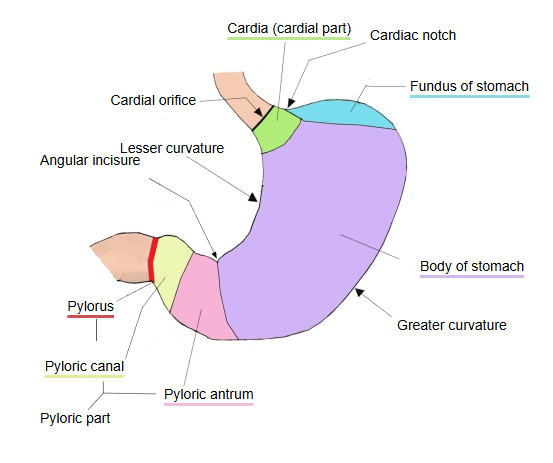
- Cardia : the area round the upper opening, where the oesophagus joins (cardial orifice, cardiac notch).
- Body : the large main part in the middle (with the gastric canal along the lesser curvature).
- Fundus : the part that bulges up and to the left of the body.
- Pyloric part : the lower part leading to the duodenum.
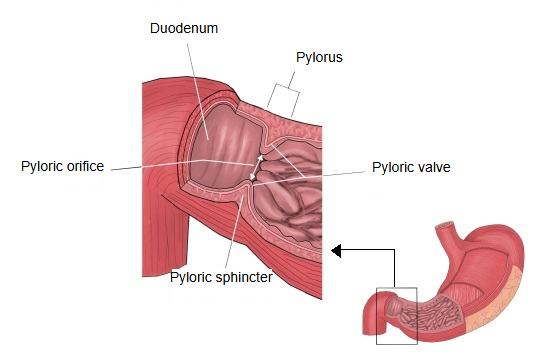
- Pylorus : the end of the stomach, at the junction with the duodenum: pyloric valve, pyloric sphincter, pyloric orifice.
- Pyloric canal : the last 2-3 cm of the stomach before the pylorus.
- Pyloric antrum : the wider part before the pyloric canal, bounded above by the angular incisure, where it meets the body.
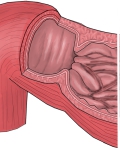 Pylorus (section)
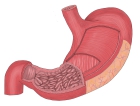 Pyloric part
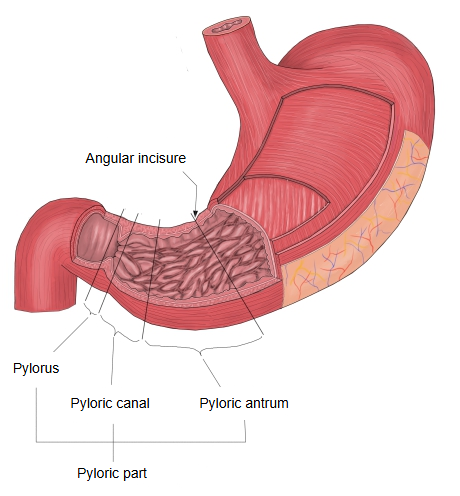
Pylorus and pyloric part
This site uses the following scheme.
1. 1. The pylorus is one part of the pyloric part.
It is the part where the stomach passes into the duodenum, with the pyloric sphincter and the pyloric valve.
The pyloric part, in contrast, is the wider region that also includes the stomach before the pylorus.
2. 2. The pyloric part can be divided into two parts, the pyloric canal and the pyloric antrum (almost all sources describe it this way).
3. 3. The pyloric canal, part of the pyloric part, does not include the pyloric valve: it is the part just before the valve.
⇒ So the pyloric canal and the pylorus are different parts, and the pyloric canal lies just before the pylorus.
4. 4. Therefore this site counts the pyloric part as pylorus + pyloric canal + pyloric antrum.
However, many sources (including Terminologia Anatomica) define the pyloric part as the pyloric canal + pyloric antrum only; in that case the pyloric canal must be taken to include the pylorus
(others list the pylorus separately, after the canal).
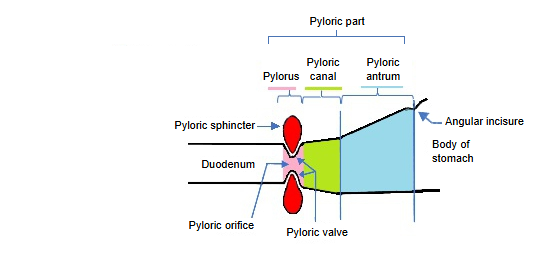
· Approximate lengths: pylorus about 1-2 cm, pyloric canal about 2-3 cm, pyloric antrum about 3-5 cm (rough figures; sources differ).
Reference websites
[Wikipedia]
· Stomach, Wikipedia.
· Pylorus, Wikipedia.
[Websites with illustrations]
· Regions of the stomach (Wikimedia Commons)

· Stomach (Kenhub)
· The stomach (TeachMeAnatomy)