Pyloric sphincter (Latin: musculus sphincter pyloricus)
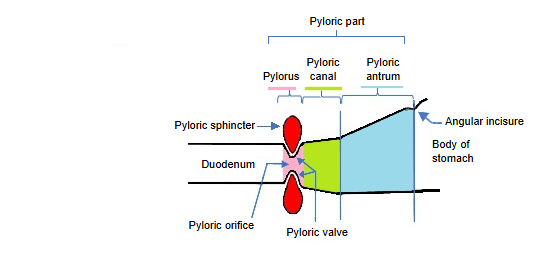
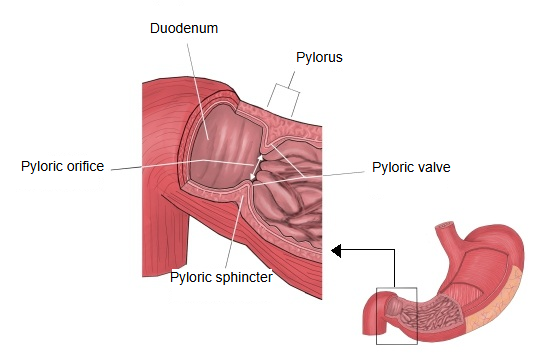
· The pyloric sphincter is the thick layer of circular smooth muscle in the wall of the pylorus, a thickening of the circular layer of the muscular coat of the stomach.
· It surrounds the pyloric orifice at the outlet of the stomach; with the mucosa covering it, it raises a ring-shaped fold around the orifice, often called the pyloric valve.
· It controls the emptying of chyme into the duodenum and limits the backflow of duodenal contents, such as bile, into the stomach.
· From the outside it can be felt as a firm ring; the prepyloric vein on its front surface marks its position.
· In infantile hypertrophic pyloric stenosis the sphincter becomes abnormally thick in young infants and blocks gastric emptying; it is treated by cutting the muscle lengthwise (pyloromyotomy).
of the
stomach
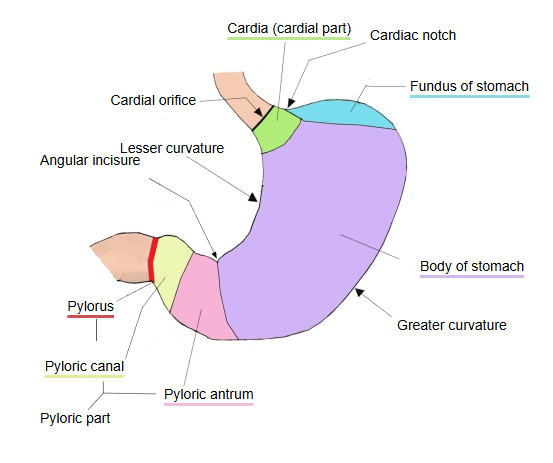
- Cardia : the area round the upper opening, where the oesophagus joins (cardial orifice, cardiac notch).
- Body : the large main part in the middle (with the gastric canal along the lesser curvature).
- Fundus : the part that bulges up and to the left of the body.
- Pyloric part : the area round the lower opening, leading to the duodenum.
- Pylorus : the end of the stomach, at the junction with the duodenum: pyloric valve, pyloric sphincter, pyloric orifice.
- Pyloric canal : the last 2-3 cm of the stomach before the pylorus.
- Pyloric antrum : the wider part before the pyloric canal, bounded above by the angular incisure, where it meets the body.
Reference websites
[Wikipedia]
· Pylorus, Wikipedia.
· Pyloric stenosis, Wikipedia.
[Websites with illustrations]
· Stomach (Kenhub)
· The stomach (TeachMeAnatomy)
· Interior of the stomach (Gray's Anatomy) (Wikimedia Commons)

Where it is found
Related terms
References and sources
- Further reading: Pylorus, Wikipedia.
- Further reading: Pyloric stenosis, Wikipedia.
- Federative International Programme for Anatomical Terminology (FIPAT). Terminologia Anatomica, 2nd ed. (TA2), 2019.