Ileocecal region (Latin: regio ileocaecalis)
- Overview
- Active immune activity
- Length of the ileocecal region
- Reference websites
- (Wikipedia, websites with illustrations)
- Where it is found
- Related terms
Overview
· The ileocecal valve is formed where the end of the ileum pushes into the cavity of the cecum. The region usually lies in the right iliac fossa and includes the terminal ileum, the ileocecal valve, the cecum and the base of the vermiform appendix; in other words, it is where the small intestine becomes the large intestine.
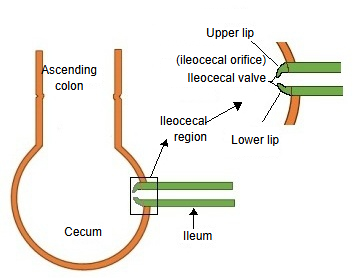
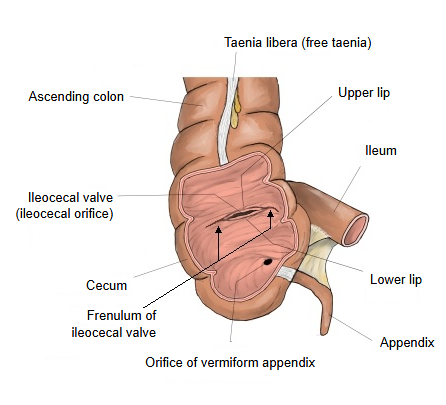
Active immune activity
1. 1. A concentration of large lymphoid tissue: the Peyer's patches
The end of the ileum (terminal ileum) is crowded with Peyer's patches, histologically distinctive groups of aggregated lymphoid nodules.
Role: they take up antigens from the gut contents, such as bacteria and viruses, and start the immune response, acting as a control centre of gut immunity.
Distribution: in one study about 46% of the Peyer's patches lay in the last 25 cm of the ileum, which shows that this area is a strong line of defence against pathogens.
2. 2. The appendix as a training ground for immunity
The appendix, which opens directly into the ileocecal region, was once thought to be useless, but recent research has shown that it is an important immune tissue.
IgA production: the appendix is rich in lymphoid tissue and is an important site for producing IgA (immunoglobulin A), which is essential for mucosal immunity.
Control of the gut flora: IgA-producing cells formed here are sent on to the large intestine and help to keep the balance of the gut bacteria.
3. 3. A sharp change in bacterial numbers, and the ileocecal valve
The ileocecal region is the border between the small intestine, with relatively few bacteria, and the large intestine, home to a huge number of bacteria.
Preventing backflow: the ileocecal valve (Bauhin's valve) limits backflow of the contents of the large intestine, but the region is still constantly exposed to bacteria coming from the large intestine, so local immune surveillance is very strong.
4. 4. Evidence: a common site of disease
Because immune activity here is so high, it is also a place where inflammation easily arises when the immune balance is upset.
It is a common site of Crohn's disease, appendicitis, intestinal tuberculosis and ileocolic intussusception.
Length of the ileocecal region
Q: How long is the ileocecal region?
A: No fixed length is defined for the ileocecal region; in reality it is a transition zone with a certain width (extent).
It cannot be given as a number because the ileocecal region is the name of a region, not of a structure; the parts it includes (the end of the ileum, the ileocecal valve and the first part of the cecum) run into one another; and individual differences are large. In practice (clinically and anatomically) it is pictured like this:
on the ileal side, a few centimetres; on the cecal side, from around the appendiceal orifice to near the bottom of the cecum.
Together it is often pictured as a zone of a few centimetres to about 10 cm, but this is not an official length.
Reference websites
[Wikipedia]
· Ileocecal valve, Wikipedia.
· Cecum, Wikipedia.
[Websites with illustrations]
· Cecum opened to show the ileocecal valve and the orifice of the appendix (figure) (Basicmedicalkey)
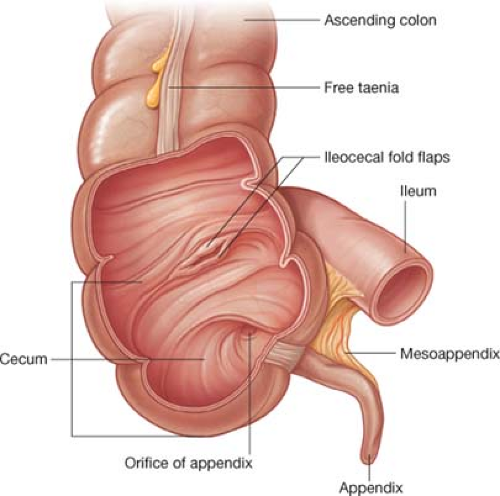
· The large intestine (cecum and ileocecal valve) (TeachMeAnatomy)
· The small intestine (ileum) (TeachMeAnatomy)
Where it is found
Related terms
References and sources
- Further reading: Ileocecal valve, Wikipedia.
- Further reading: Cecum, Wikipedia.
- Federative International Programme for Anatomical Terminology (FIPAT). Terminologia Anatomica, 2nd ed. (TA2), 2019.