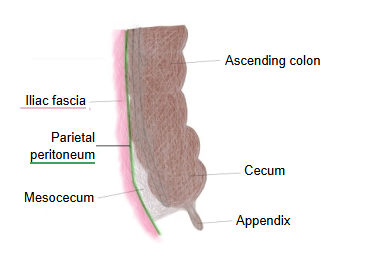
Mesocecum (Latin: mesocaecum)
Also called Mesocaecum
The mesocecum is a kind of mesentery, but in most people it is absent, because the cecum usually lies directly on the posterior wall and has no true mesentery of its own.
Mesentery: one of the structures by which the peritoneum reaches into the abdominal cavityCecum: one of the intraperitoneal organs; covered by peritoneum on almost all sides
Usually the cecum is covered by peritoneum on almost all sides but has no true mesentery; it lies against the iliac fascia in the right iliac fossa. In some people a short mesocecum is present (see also the mesoappendix of the appendix and the ileocecal region).
Structures
of the
peritoneum
reaching into
the abdominal
cavity
of the
peritoneum
reaching into
the abdominal
cavity
- Mesentery : a double layer of peritoneum that joins an organ to the parietal peritoneum of the wall; the path of its vessels and nerves. Examples: the mesentery of the small intestine, the transverse mesocolon and others.
- Peritoneal folds : a single layer: ridges on the inner surface of the anterior abdominal wall raised by vessels and cords. Examples: the median, medial and lateral umbilical folds.
- Omentum : peritoneum that wraps the stomach and continues up and down from its borders. Lesser omentum: stomach to liver, a double layer. Greater omentum: hangs down like a curtain; the double layer is folded back on itself, so its central part is a fused four-layered sheet.
- Peritoneal ligaments : a double layer that joins an organ to the abdominal wall or to another organ and holds it in place. Examples: the falciform ligament, the gastrosplenic ligament.
When present, the mesocecum attaches the cecum to the posterior abdominal wall. Its length varies a great deal between individuals: it may be very short, or in some people quite long (3 cm or more).
The figures below are rough estimates; sources differ on how often a mesocecum is found and on whether a short one is counted as a mesocecum.
Usual: when present, it is often about 1–2 cm long.
Short: only a few millimetres.
Long: 3 cm or more, reported in roughly 15–30% of people in Japanese data. ⇒ It lets the cecum move freely and predisposes to a mobile cecum, and so to cecal volvulus.