Fornix of stomach (Latin: fornix gastricus)
Also called the gastric fornix
· Some textbooks do not use this name in their description of the stomach.
The description below follows Terminologia Anatomica (TA).
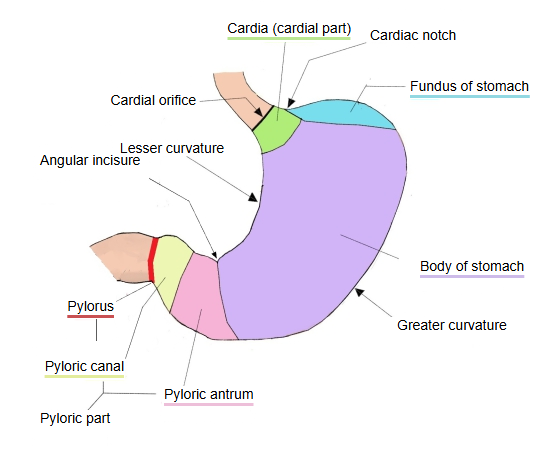
The fornix was formerly treated as a synonym of the fundus of the stomach (fundus), but TA lists the fundus and the fornix as separate terms. The fundus, found in every stomach, is the top part of the stomach above the level of the cardial orifice, passing into the body below; its mucosa is very thick. The fornix is the highest, dome-shaped part of the fundus.
· It lies directly under the left dome of the diaphragm. On its right it is separated from the esophagus by the cardiac notch.
· In an upright person it usually holds swallowed air, seen on radiographs as the gastric air bubble.
· Many texts still use the names fornix and fundus for the same part. Sources differ.
Related terms
References and sources
- Further reading: Stomach, Wikipedia.
- Federative International Programme for Anatomical Terminology (FIPAT). Terminologia Anatomica, 2nd ed. (TA2), 2019.