Cardiac notch (Latin: incisura cardiaca pulmonis sinistri; incisura cardialis gastris)
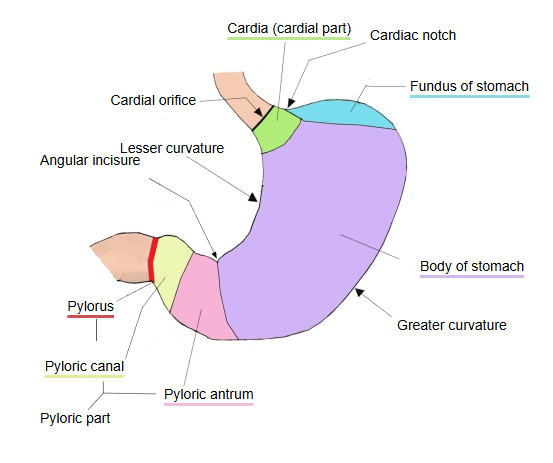
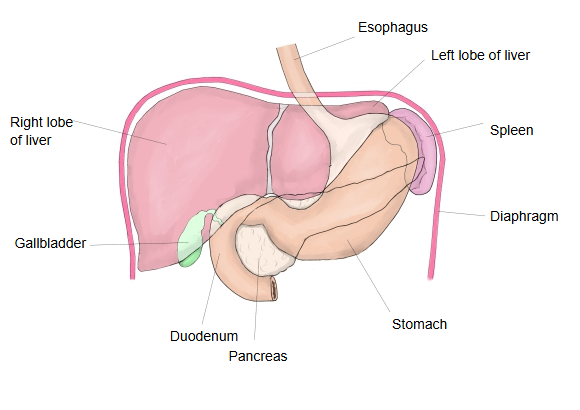
· It is the sharp angle (about 50-80°) on the left side of the cardial orifice, between the left margin of the esophagus at the cardia and the fundus on its left. It is also called the angle of His (esophagogastric angle).
· Inside the stomach, the notch corresponds to a mucosal fold that is thought to act as a flap valve and to help prevent reflux of gastric contents into the esophagus.
· The same name is also used for the cardiac notch of the left lung (see below); in everyday English, "cardiac notch" on its own usually means the lung notch. The two share only the word "cardiac": the lung notch is named after the heart, the stomach notch after the cardia of the stomach.
of the
stomach
- Parts of the sac
- Cardia : the area round the upper opening, where the oesophagus joins (cardial orifice, cardiac notch).
- Body : the large main part in the middle (with the gastric canal along the lesser curvature).
- Fundus : the part that bulges up and to the left of the body.
- Pyloric part : the area round the lower opening, leading to the duodenum (pylorus, pyloric orifice, pyloric valve).
- Curvatures
- Greater curvature : the lower (left) border joining the cardia and the pylorus, where the front and back walls meet.
- Lesser curvature : the upper (right) border joining the cardia and the pylorus, where the front and back walls meet.
- Walls
- Anterior wall : the surface between the two curvatures that faces forwards and upwards.
- Posterior wall : the surface between the two curvatures that faces backwards and downwards.
Cardiac notch of the left lung
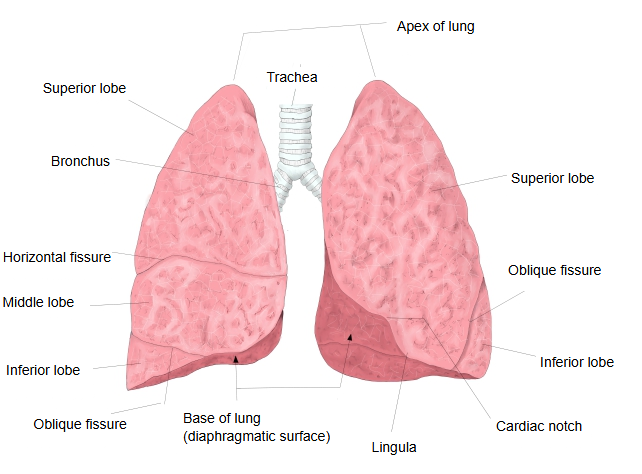
· A deep concave notch in the lower part of the anterior border of the left lung, made by the heart bulging to the left.
· Below it, a small tongue-like part of the superior lobe, the lingula, curves forward under the heart.
· In the notch, the pericardium lies against the chest wall without lung in front of it. The pleura does not follow the lung edge exactly here, so the anterior border of the lung lies a little lateral to the line of pleural reflection (cardiac notch of the pleura).
· This bare area is the basis of the area of superficial cardiac dullness on percussion, roughly at the left fourth to sixth costal cartilages.
Reference websites
[Wikipedia]
· Cardiac notch of the stomach (angle of His), Wikipedia.
· Cardiac notch of left lung, Wikipedia.
· Lung, Wikipedia.
[Websites with illustrations]
· Stomach (Kenhub)
· The stomach (TeachMeAnatomy)
· The lungs (TeachMeAnatomy)
Where it is found
Related terms
References and sources
- Further reading: Lung, Wikipedia.
- Further reading: Cardiac notch of left lung, Wikipedia.
- Further reading: Cardiac notch of the stomach (angle of His), Wikipedia.
- Federative International Programme for Anatomical Terminology (FIPAT). Terminologia Anatomica, 2nd ed. (TA2), 2019.