Tendinous arch of levator ani (Latin: arcus tendineus musculi levatoris ani)
Also called Tendinous arch of obturator fascia (older name)
This name is not found in the index of some standard anatomy books, and few sources use it.
The following is based on the descriptions of the levator ani and of the obturator internus fascia in a classical anatomy textbook.
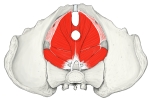 Pelvic floor muscles (female) from above
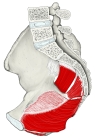 Pelvic floor muscles (side view)
On the levator ani:
The left and right levator ani, together with the coccygeus, form a funnel-shaped sheet of muscle that closes the pelvic outlet; it is therefore also called the pelvic diaphragm. Between the front borders of the two levator ani there is a gap in the midline, the levator hiatus, into which the apex of the prostate fits. Each levator ani arises along a line from the back of the pubic symphysis to the ischial spine: its muscle fibres arise in front from the back (pelvic surface) of the body of the pubis and the superior pubic ramus, lateral to the symphysis, behind from the ischial spine, and in between from the tendinous arch of the obturator fascia. The fibres pass backwards along the sides of the bladder, the prostate (or vagina) and the rectum; they are firmly attached to the prostate, and the longitudinal muscle layer of the rectum ends between its bundles, so the muscle is closely joined to the rectal wall. The pubococcygeus and especially the iliococcygeus take origin from the arch; the puborectalis arises from the pubis in front of it.
On the obturator internus fascia:
The obturator internus fascia, which covers obturator internus on the side wall of the pelvis, forms a fairly strong arched band in line with the back edge of the inner opening of the obturator canal, a little below and behind it; this is the tendinous arch of the obturator fascia. It runs from the back of the body of the pubis to the ischial spine, and its strength and exact course vary greatly between individuals. Do not confuse it with the tendinous arch of pelvic fascia, a separate band lower on the pelvic floor that anchors the fascia of the pelvic organs.
Reference websites
[Wikipedia]
· Tendinous arch of levator ani, Wikipedia.
· Levator ani, Wikipedia.
[Websites with illustrations]
· The pelvic diaphragm, superior view of the female pelvis (Pinterest)

· Muscles of the pelvic floor (OpenStax Anatomy and Physiology) (Wikimedia Commons)

Related terms
References and sources
- Further reading: Tendinous arch of levator ani, Wikipedia.
- Further reading: Levator ani, Wikipedia.
- Federative International Programme for Anatomical Terminology (FIPAT). Terminologia Anatomica, 2nd ed. (TA2), 2019.