Tendinous arch of pelvic fascia (Latin: arcus tendineus fasciae pelvis)
Also called White line of the pelvis
· Because of its whitish look it is also called the white line (arcus tendineus fasciae pelvis).
· It is a narrow, pale band, from a few millimetres to just under a centimetre wide.
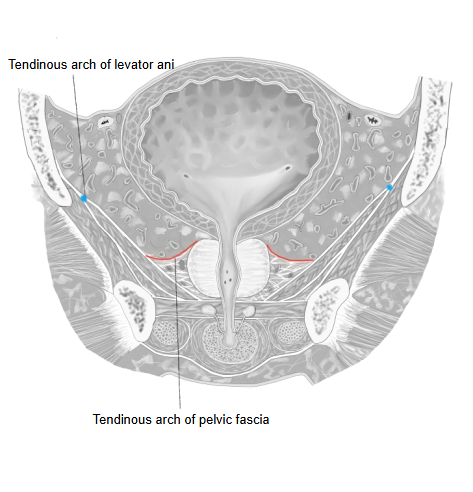
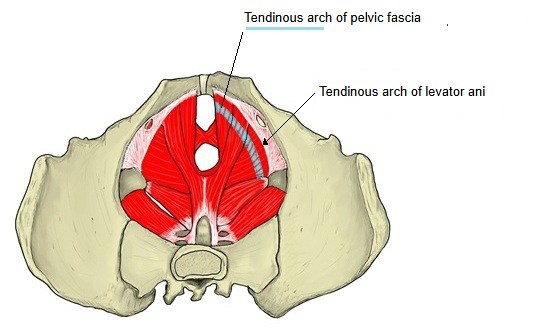
Course: from the back of the pubis backwards to the ischial spine, running roughly parallel to the tendinous arch of levator ani (below and medial to it, on the upper surface of the fascia of the levator ani).
Function: support of the organs (a hammock-like structure); steadying of the muscles (an intermediate attachment).
Support of the organs: it ties the fascia around the pelvic organs (the urinary bladder, urethra, vagina and rectum) firmly to the side wall of the pelvis, so that they do not sag; in women it gives lateral support to the front wall of the vagina. Its front part, near the pubis, forms the pubovesical ligament in women and the puboprostatic ligament in men.
Steadying of the muscles: it is fused with the fascia on the upper surface of the levator ani, over the iliococcygeus and pubococcygeus; these muscles themselves arise from the tendinous arch of levator ani.
Note: do not confuse it with the tendinous arch of levator ani, the thickening of the obturator fascia from which the levator ani arises. Some texts use the two names loosely. See also pelvic fascia (parietal and visceral) and pelvic diaphragm.
 Urinary bladder (coronal section)
 Pelvic floor muscles
Reference websites
· Pelvic diaphragm, superior view of the female pelvis (figure), Pinterest.

Related terms
- Tendinous arch of levator ani
- Pelvic fascia
- Parietal pelvic fascia
- Visceral pelvic fascia
- Levator ani
- Pelvic diaphragm
- Ischial spine
References and sources
- Further reading: Tendinous arch of pelvic fascia, Wikipedia.
- Further reading: Pelvic floor, Wikipedia.
- Federative International Programme for Anatomical Terminology (FIPAT). Terminologia Anatomica, 2nd ed. (TA2), 2019.