Plane joint (Latin: articulatio plana)
Also called Gliding joint, arthrodial joint
· It is enclosed by a tight articular capsule and ligaments, which limit its movement.
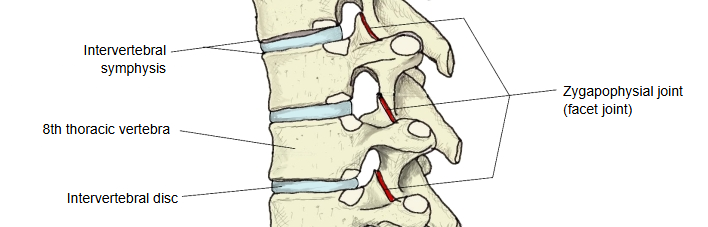
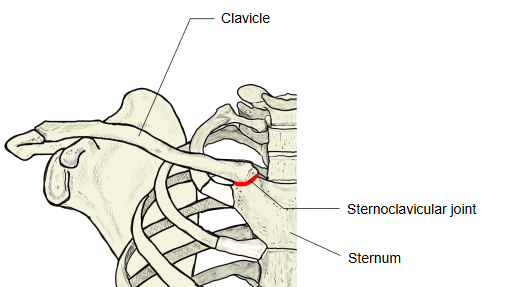
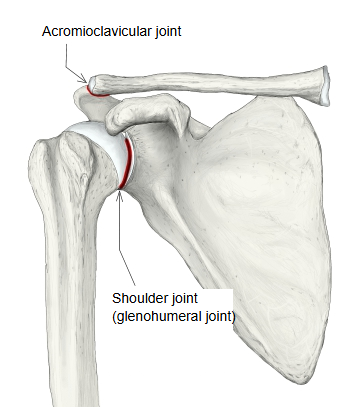
Examples: the zygapophysial (facet) joints of the vertebrae, the sternoclavicular joint (sources differ; see below) and the acromioclavicular joint.
Sources differ on some examples: the sternoclavicular joint is listed as a plane joint in some texts, but most English-language texts class it as a saddle joint that works like a ball-and-socket joint because of its articular disc.
joints
- Uniaxial joints : move about one axis only: hinge joints, spiral joints and pivot joints.
- Biaxial joints : move about two axes at right angles: ellipsoid joints (= condylar joints) and saddle joints.
- Multiaxial joints : move about three or more axes: ball-and-socket joints (enarthroses) and plane joints.
In more detail:
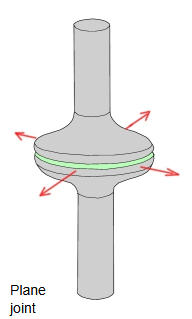
In theory a plane joint allows sliding in any direction and rotation about any axis at right angles to the surfaces, so it is counted as multiaxial; in practice the movements are small and almost only gliding, because the surfaces are nearly flat. The intercarpal joints, most intertarsal joints, the tarsometatarsal joints and the zygapophysial joints belong to this group. The sacroiliac joint is a plane-type joint whose surfaces carry many small, interlocking bumps, so that it hardly moves; such a joint is called an amphiarthrosis.
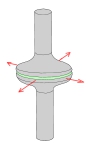 Plane joint (model)
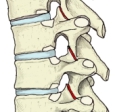 Zygapophysial joints
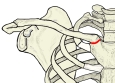 Sternoclavicular joint
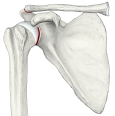 Acromioclavicular joint
Reference websites
[Wikipedia]
· Plane joint, Wikipedia.
· Synovial joint, Wikipedia.
[Websites with illustrations]
· Plane joints between the navicular and the cuneiforms, with a gliding model (Pinterest (image))

Related terms
- Acromioclavicular joint
- Sternoclavicular joint
- Intercarpal joints
- Tarsometatarsal joints
- Sacroiliac joint
- Carpometacarpal joints
References and sources
- Further reading: Plane joint, Wikipedia.
- Further reading: Synovial joint, Wikipedia.
- Federative International Programme for Anatomical Terminology (FIPAT). Terminologia Anatomica, 2nd ed. (TA2), 2019.