Gray matter (Latin: substantia grisea)
Also called Grey matter or the grey substance
· In the brain and spinal cord, the parts where neuron cell bodies are gathered contain no or very few myelinated nerve fibres and so look grey; hence the name.
· Gray matter contains the cell bodies of neurons, dendrites, the first parts of axons, axon terminals and synapses, glial cells and blood vessels (a dense network of capillaries).
· In contrast to gray matter, the white parts without neuron cell bodies, made almost only of myelinated nerve fibres, are called white matter.
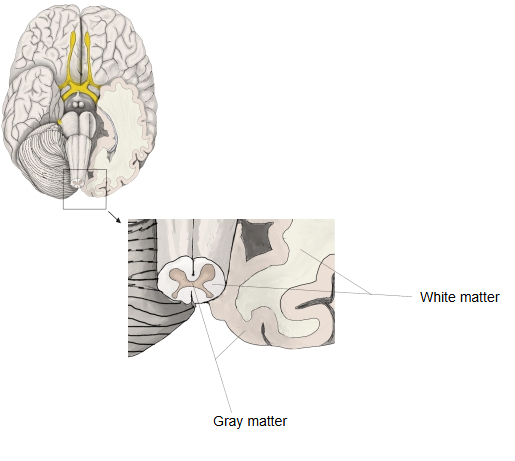
· Gray matter is where information is received, processed and passed on; white matter carries it between areas of gray matter.
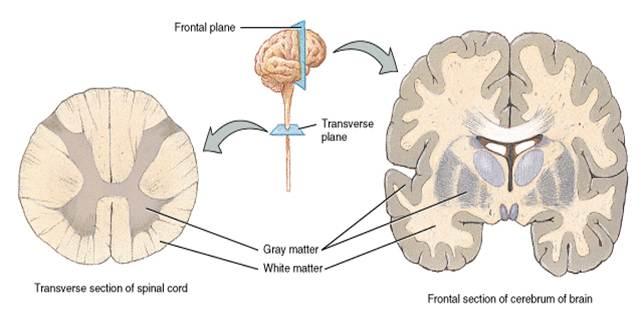
· In the brain the gray matter lies mainly on the surface (cortex) and in deep nuclei; in the spinal cord it lies in the centre, surrounded by white matter.
Main sites
The main sites of gray matter are:
gray matter
in the central
nervous system
- Cerebral and cerebellar cortex : the thin surface layer of the cerebrum and of the cerebellum.
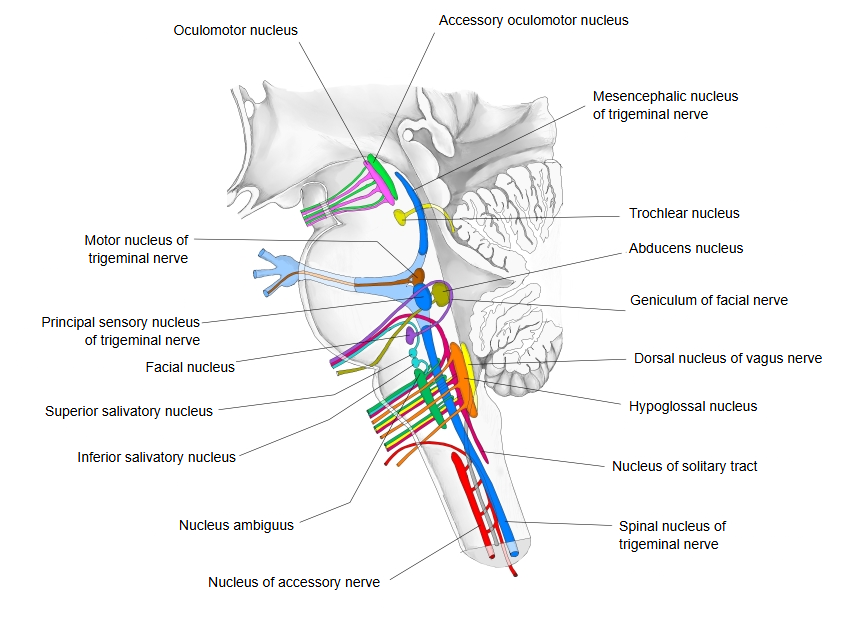
- Nuclei : lump-like parts inside the central nervous system, each with its own name, e.g. the nucleus ambiguus, the salivatory nuclei, the spinal nucleus of the trigeminal nerve, the nuclei of the other cranial nerves, the basal nuclei and the thalamus.
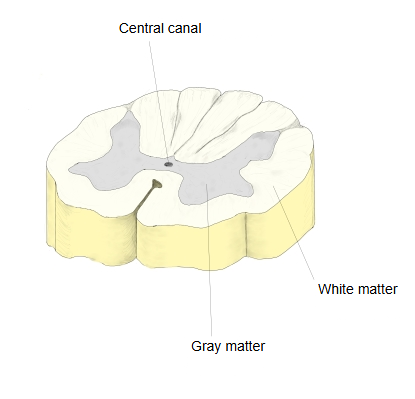
- Gray columns : the central part of the spinal cord, H-shaped in cross-section: two pairs of horns (anterior and posterior) and the part joining them; a lateral horn is added in the thoracic and upper lumbar segments.
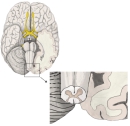 Gray and white matter of the brain and spinal cord
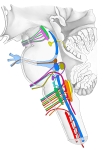 Cranial nerve nuclei (brainstem)
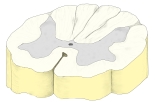 Spinal cord (cross-section)
Reference websites
[Wikipedia]
· Grey matter, Wikipedia.
· White matter, Wikipedia.
[Websites with illustrations]
· Gray and white matter in sections of the spinal cord and cerebrum (guardianlv.com)
· Human brain, dissected lateral view (labelled) (Wikimedia Commons)

Where it is found
- Cortex: the thin outer layer of the cerebrum (cerebral cortex) and of the cerebellum (cerebellar cortex).
- Nuclei: groups of neuron cell bodies inside the brain, such as the basal nuclei, the thalamus and the nuclei of the cranial nerves in the brainstem (for example the hypoglossal nucleus and the nucleus ambiguus).
- Gray columns of the spinal cord: the central gray matter, H-shaped or butterfly-shaped in cross-section, with anterior and posterior horns (and a lateral horn in the thoracic and upper lumbar segments) around the central canal.
Related terms
- Spinal cord
- Brain
- Cranial nerves
- Trigeminal nerve
- Parasympathetic outflow of the midbrain
- Parasympathetic outflow of the hindbrain
References and sources
- Further reading: Grey matter, Wikipedia.
- Further reading: White matter, Wikipedia.
- Federative International Programme for Anatomical Terminology (FIPAT). Terminologia Anatomica, 2nd ed. (TA2), 2019.