Dendrite (Latin: dendritum)
A neuron has a cell body, usually several dendrites and, as a rule, a single axon: the dendrites bring signals towards the cell body and the axon carries them away. Most of the synapses of a neuron lie on its dendrites. Most neurons have many dendrites, but some have only one; the more dendrites a neuron has, the more synaptic contacts it can receive.
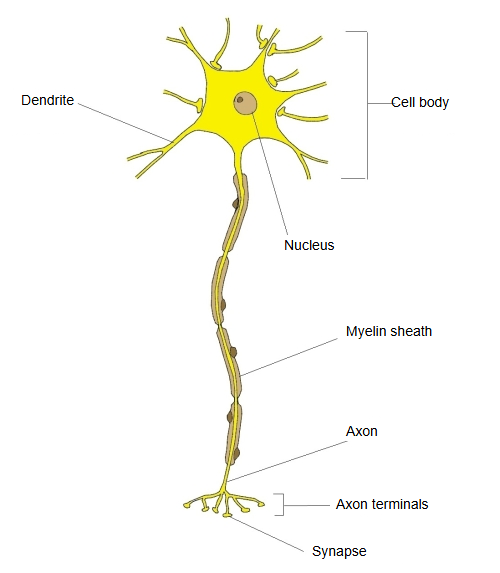
Special cases
· In some neurons, such as the Purkinje cells of the cerebellum, action potentials can also arise in the dendrites.
· In a pseudounipolar neuron, the long peripheral process is sometimes called a dendrite by its shape, but it conducts action potentials like an axon.
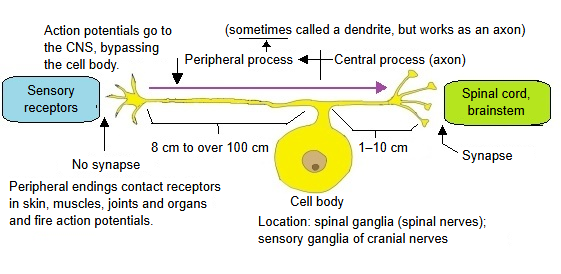
Hormones and dendrites
Can the dendrites of a neuron respond to hormones and other substances, not only to signals at a synapse? And can such substances start an action potential?
They can respond.
How?
Besides the receptors at synapses, the dendrites and cell body of a neuron can carry receptors for hormones and for modulating substances (neuromodulators).
These substances reach the cell through the blood or the extracellular fluid and change how excitable the cell is and how strongly its synapses transmit.
What effects can they have?
Direct changes in the membrane potential (for example, by opening or closing ion channels).
Regulation of synaptic plasticity (long-term potentiation, LTP, and long-term depression, LTD).
Changes in gene expression (slow, lasting changes in structure and function).
In most cases the effect of a hormone is slow and lasting, and does not itself fire an action potential at once.
Do hormones start action potentials?
As a rule, a hormone alone hardly ever starts an action potential directly. It can, however, make the neuron more excitable and so change the threshold at which other synaptic input fires an action potential.
Examples:
| Hormone / substance | Effect |
|---|---|
| Adrenaline | makes neurons more excitable |
| Serotonin | modulates nerve activity; involved in mood and arousal |
| Cortisol | affects the stress responses of the nervous system |
| Oxytocin | modulates social behaviour and emotional responses |
Reference websites
[Wikipedia]
· Dendrite, Wikipedia.
· Neuron, Wikipedia.
· Dendrite, The Free Dictionary (medical dictionary).
[Websites with illustrations]
· Neuron with dendrites, cell body, axon and myelin sheath (Stack Exchange)

· Complete neuron cell diagram (Wikimedia Commons)

Related terms
- Axon
- Synapse
- Nerve fibre
- Axon terminal
- Chemical synapse
- Electrical synapse
- Interneuron
- Sensory nerve
- Gray matter
- Hormone