Superior thoracic aperture (Latin: apertura thoracis superior)
Also called the thoracic inlet, inlet of thorax
The superior thoracic aperture is the upper opening of the thoracic cage: the opening bounded by the body of the 1st thoracic vertebra, the 1st ribs (with their cartilages) and the superior border of the manubrium of the sternum.
It is the upward outlet of the thoracic cavity. As a whole its plane slopes downward and forward: the superior border of the manubrium (the jugular notch) lies at about the level of the lower border of the 2nd thoracic vertebral body in men, and a little lower in women (sources give the 2nd to 3rd thoracic vertebrae).
· It is kidney-shaped and small, roughly 5 cm from front to back and 10 cm across.
· Through it pass the trachea, the oesophagus, the great vessels to and from the head and upper limbs, the vagus and phrenic nerves and the thoracic duct; the apex of each lung, covered by the cervical pleura, rises through it into the root of the neck. The space between the two lungs below it is the mediastinum.
thoracic
aperture
- Body of the 1st thoracic vertebra
- 1st rib
- Manubrium of sternum (superior border)
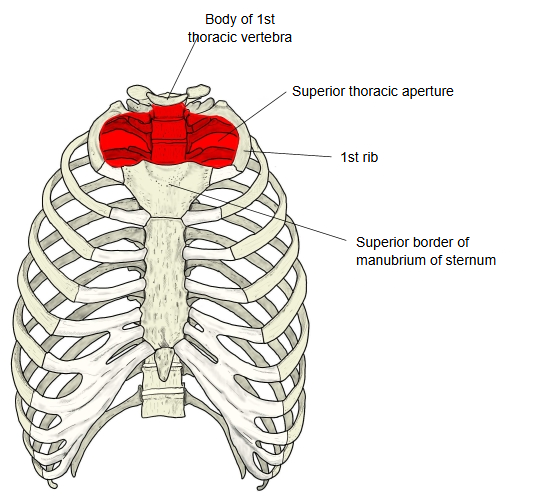
The opening has several English names: superior thoracic aperture (the official term), thoracic inlet and inlet of thorax.
Clinicians often call this region the thoracic outlet (as in thoracic outlet syndrome); sources differ in their use of inlet and outlet.
Reference websites
[Wikipedia]
· Superior thoracic aperture, Wikipedia.
[Websites with illustrations]
· Thoracic cage with the thoracic inlet, sternal angle and thoracic outlet (SlideShare)

· Thoracic cage with the superior thoracic aperture shaded (Memrise)

Related terms
References and sources
- Further reading: Thoracic inlet, Wikipedia.
- Federative International Programme for Anatomical Terminology (FIPAT). Terminologia Anatomica, 2nd ed. (TA2), 2019.