Groove of promontory (Latin: sulcus promontorii)
Also called the promontory groove
The groove of the promontory is a groove on the promontory of the tympanic cavity that holds a nerve, the tympanic nerve (a branch of the glossopharyngeal nerve).
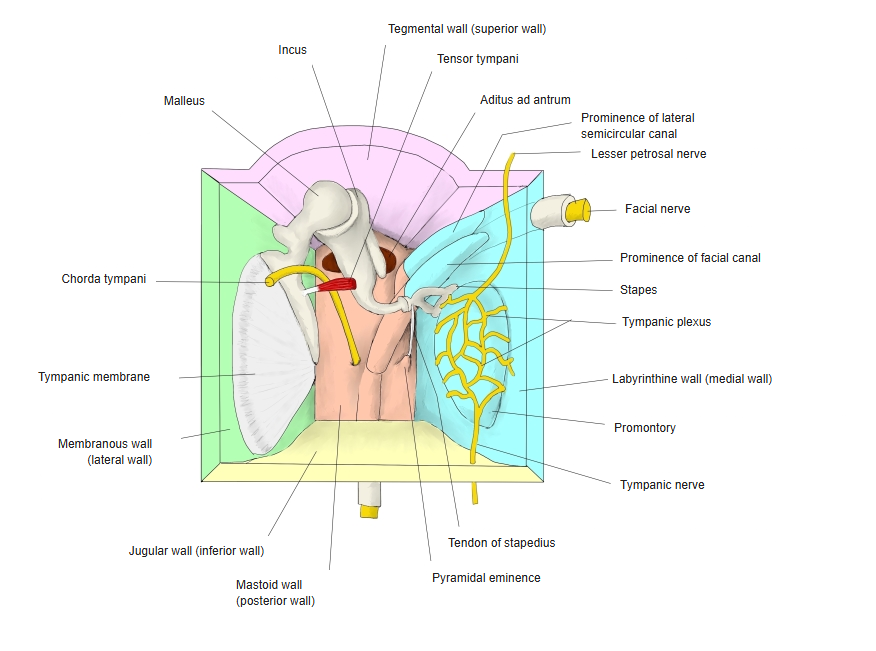
Promontory: the rounded bulge on the medial wall of the tympanic cavityOn the promontory the tympanic nerve is joined by a communicating branch from the facial nerve and by the caroticotympanic nerves, forming the tympanic plexus
Just below the oval window lies a rounded bulge, the promontory, raised by the first (basal) turn of the cochlea. Across its surface runs a fine vertical groove, the groove of the promontory, which holds the tympanic nerve and the tympanic plexus. Below, it starts at the tympanic opening of the tympanic canaliculus, which comes up from the petrous fossula; above, it ends at a small opening between the oval window and the cochleariform process. The round window lies below and behind the promontory.
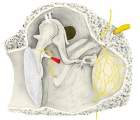 Tympanic cavity (section)
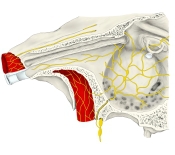 Tympanic nerve and plexus
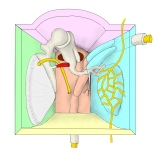 Tympanic cavity (diagram)
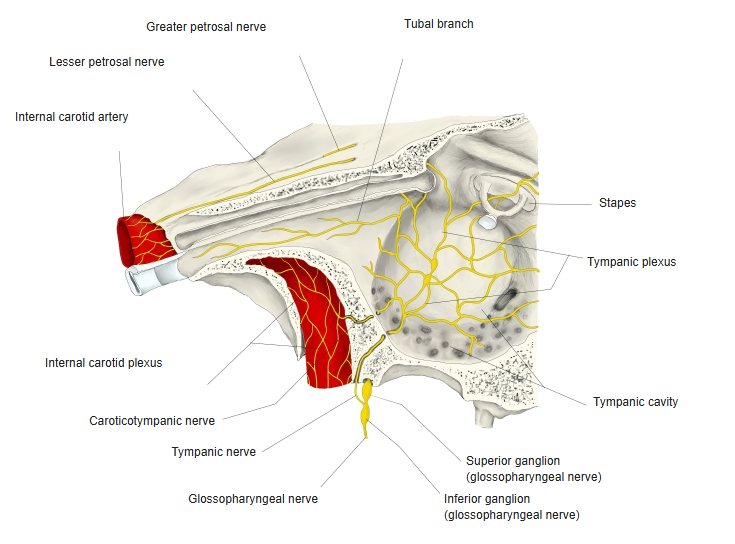
Related terms
- Tympanic cavity
- Tympanic nerve
- Glossopharyngeal nerve
- Caroticotympanic nerve
- Oval window
- Round window
- Cochlea
References and sources
- Further reading: Tympanic cavity, Wikipedia.
- Federative International Programme for Anatomical Terminology (FIPAT). Terminologia Anatomica, 2nd ed. (TA2), 2019.