Epiglottic tubercle (Latin: tuberculum epiglotticum)
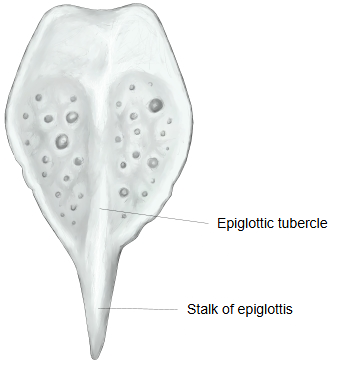
The epiglottic cartilage and the tubercle:
The epiglottic cartilage is an unpaired elastic cartilage. It is the flat cartilage that forms the framework of the epiglottis, shaped like a spoon with a hollow back surface; it lies at the inlet of the larynx, against the root of the tongue. Its lower part narrows like a handle into the stalk of the epiglottis, which is joined by the thyroepiglottic ligament to the midline of the back of the lamina of the thyroid cartilage. The small elevation of the mucosa on the back surface above the stalk is the epiglottic tubercle. The front surface of the cartilage is convex and faces the tongue (lingual surface); the back surface is concave and faces the larynx (laryngeal surface).
· The tubercle lies in the midline of the laryngeal surface, where the broad upper part of the cartilage narrows into the stalk. Covered by mucosa, it projects backwards into the front wall of the laryngeal vestibule, above the front ends of the vestibular and vocal folds.
· It is a landmark when the larynx is viewed from above, as in laryngoscopy.
Reference websites
[Wikipedia]
· Epiglottis, Wikipedia.
Related terms
References and sources
- Further reading: Epiglottis, Wikipedia.
- Federative International Programme for Anatomical Terminology (FIPAT). Terminologia Anatomica, 2nd ed. (TA2), 2019.