Bony ampullae (Latin: ampullae osseae)
Also called the osseous ampullae
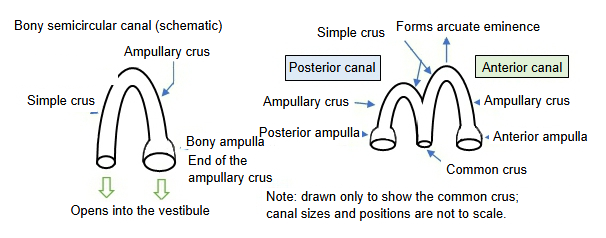
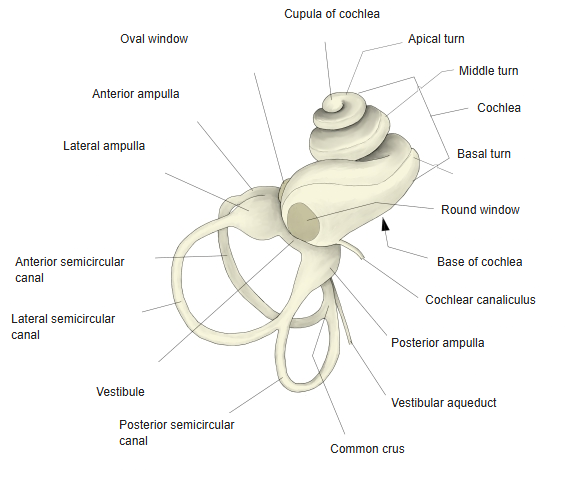
A bony ampulla is the swollen part at the end of the (bony) ampullary crus, one of the two crura of each bony semicircular canal; it opens into the vestibule.
The two crura: the (bony) simple crus and the (bony) ampullary crusBony semicircular canals: three C-shaped tubes forming the back part of the bony labyrinth of the internal earThree bony ampullae: the anterior, lateral and posterior (bony) ampullae
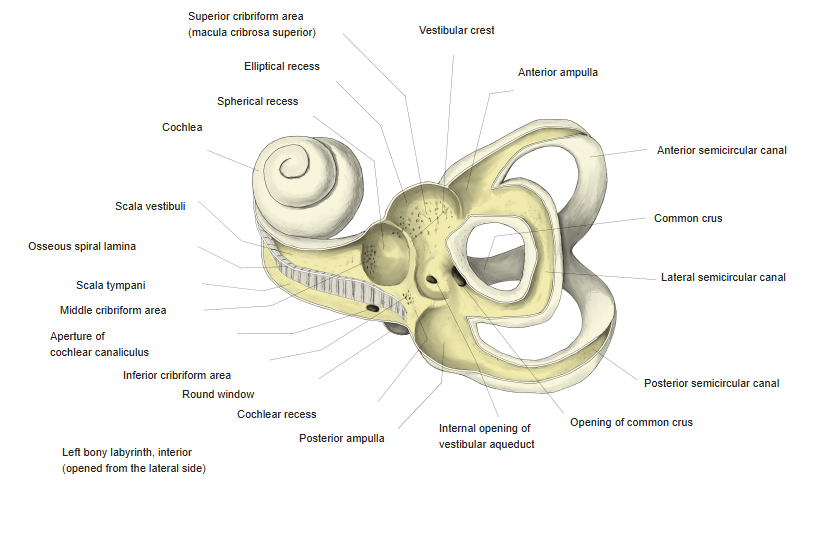
· The anterior and lateral ampullae open close together into the upper part of the vestibule; the posterior ampulla opens into its lower back part.
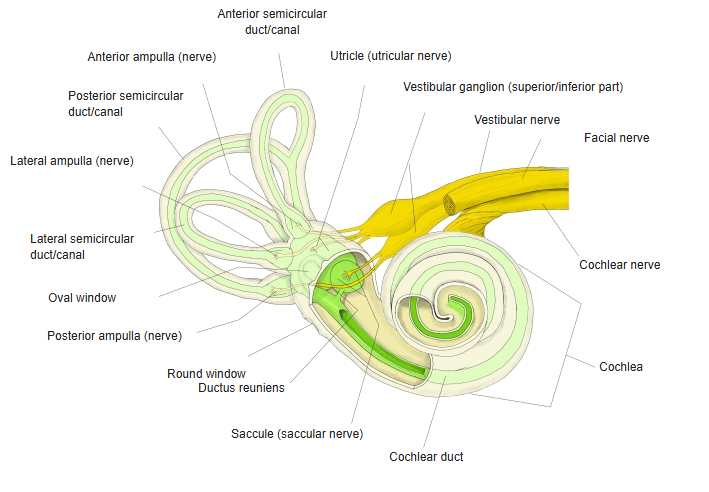
· Each one houses a membranous ampulla (membranous ampullae) of a semicircular duct, with its ampullary crest, the sensory organ for rotation of the head.
· The simple crura of the anterior and posterior canals join to form the common bony crus, which opens into the back of the vestibule; the simple crus of the lateral canal opens on its own.
- Anterior canal
- Simple crus : joins the simple crus of the posterior canal; as the (bony) common crus it opens into the medial wall of the back part of the vestibule.
- Ampullary crus → anterior bony ampulla : opens into the upper part of the vestibule, near the elliptical recess.
- Lateral canal
- Ampullary crus → lateral bony ampulla : opens into the vestibule just below the anterior ampulla, lateral to the elliptical recess.
- Simple crus : opens on its own into the back of the vestibule, between the common crus and the posterior ampulla.
- Posterior canal
- Simple crus : joins the simple crus of the anterior canal to form the common crus.
- Ampullary crus → posterior bony ampulla : opens into the lower back part of the vestibule.
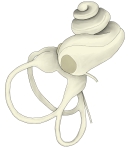 Bony labyrinth
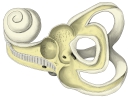 Bony labyrinth (opened)
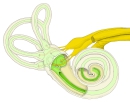 Labyrinth and nerves
Related terms
- Lateral bony ampulla
- Posterior bony ampulla
- Ampullary crest
- Lateral semicircular canal
- Posterior semicircular canal
- Semicircular canals
- Vestibule
References and sources
- Further reading: Semicircular canals, Wikipedia.
- Further reading: Bony labyrinth, Wikipedia.
- Federative International Programme for Anatomical Terminology (FIPAT). Terminologia Anatomica, 2nd ed. (TA2), 2019.