Non-visual retina (Latin: Pars caeca retinae)
Also called the blind part of retina
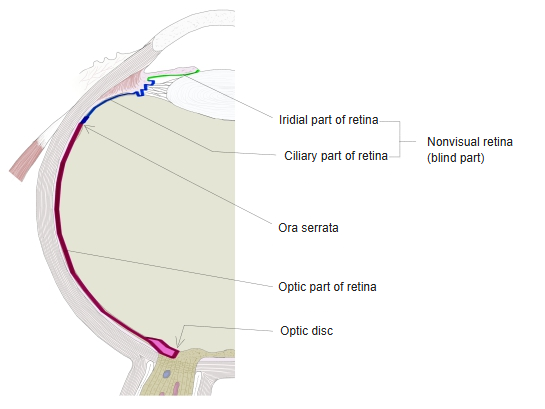
The blind part of the retina is the part of the retina, which has three parts, that lies in front of the ora serrata and does not sense light; it has two parts.
Retina: the innermost layer of the wall of the eyeball (inner layer of the eyeball)Two parts: the ciliary part and the iridial part of the retina
Parts
of the
retina
of the
retina
- Optic part of the retina : the part that senses light; made of nerve cells and connective (supporting) tissue, in which 10 layers can be distinguished. Its front border is the ora serrata.
- Blind part of the retina : does not sense light; begins in front of the ora serrata.
- Ciliary part of the retina : covers the inner surface of the ciliary body; two layers of epithelial cells, the outer one pigmented, the inner one without pigment.
- Iridial part of the retina : covers the back of the iris; two layers of epithelial cells, both heavily pigmented.
The blind part is the forward continuation of the optic part of the retina; the border between them is the ora serrata. It is only a thin two-layered epithelium, without photoreceptors or nerve cells, which is why it cannot sense light.
Related terms
- Optic part of retina
- Ciliary part of retina
- Iridial part of retina
- Retina
- Ora serrata
- Ciliary body
- Iris
- Inner layer of eyeball
- Eyeball
References and sources
- Further reading: Retina, Wikipedia.
- Federative International Programme for Anatomical Terminology (FIPAT). Terminologia Anatomica, 2nd ed. (TA2), 2019.