Ciliary crown (Latin: corona ciliaris)
Also called the pars plicata (folded part of the ciliary body)
· The ciliary crown in front is about 2-3 mm wide; the ciliary ring behind it is about 4 mm wide (sources differ on both widths).
- Ciliary crown (front)
- Ciliary processes : about 70 radial folds rich in capillaries; they produce the aqueous humor.
- Ciliary folds : low folds between the ciliary processes.
- Ciliary ring (back) : a band about 4 mm wide that meets the ora serrata; many fine ridges run on its inner surface.
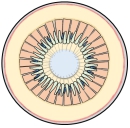 Ciliary body seen from inside
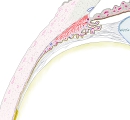 Ciliary body (section)
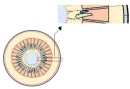 Ciliary crown and ciliary ring (enlarged)
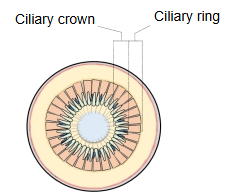
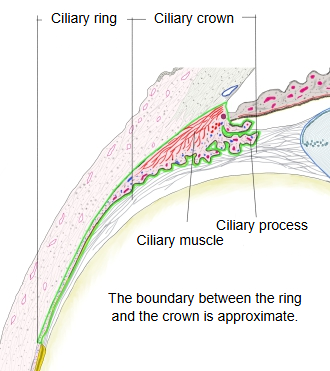
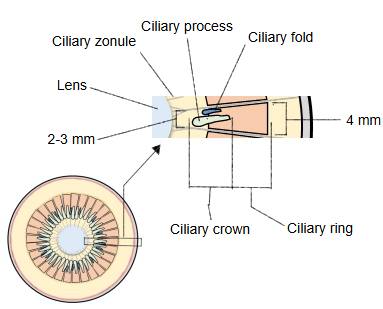
The back part of the ciliary body, about 4 mm wide, has shallow grooves and ridges running along the meridians; it is called the ciliary ring (pars plana). The part in front of it, about 2-3 mm wide, is the ciliary crown (pars plicata): some 70 ciliary processes (sources differ on the number) project from it in a meridional pattern, and together with the ciliary folds between them they form a pleated ring like a crown. Fine fibres, the ciliary zonule, stretch between the valleys between the processes and the lens. All this is seen clearly when the front half of the eyeball is viewed from inside after removal of the vitreous body. The processes also secrete the aqueous humor.
When the eyeball is cut at the equator and its front half is viewed from behind, the ciliary body can be seen all the way round the lens. Two zones are distinguished: (1) the ciliary ring, continuous with the ora serrata (its width is given differently in different descriptions; see above), and (2) the ciliary crown, made of about 70 radially arranged processes and the folds between them. Fine meridional ridges on the ring converge to form the ciliary processes (each about 2 mm long, 1 mm wide and 0.5 mm high).
Reference websites
[Wikipedia]
· Ciliary body, Wikipedia.
[Websites with illustrations]
· Structure of the ciliary body (figure) (BrainKart)

· Ciliary body, processes and zonule (figure) (The Free Dictionary (medical))

Related terms
- Ciliary ring
- Ciliary folds
- Ciliary processes
- Ciliary zonule
- Ciliary margin of iris
- Circular fibres of ciliary muscle
- Ciliary body
- Ora serrata
- Lens
- Aqueous humor
- Radial fibers of ciliary muscle
- Vascular layer of eyeball
References and sources
- Further reading: Ciliary body, Wikipedia.
- Federative International Programme for Anatomical Terminology (FIPAT). Terminologia Anatomica, 2nd ed. (TA2), 2019.