Lacrimal caruncle (Latin: caruncula lacrimalis)
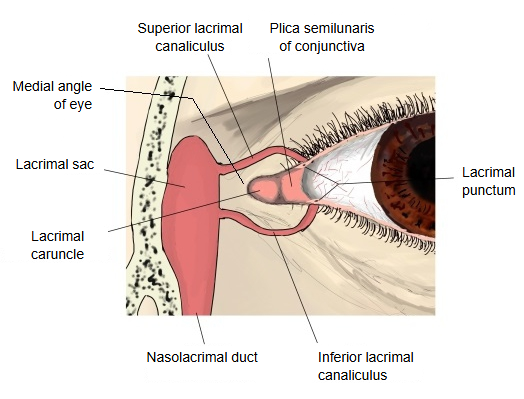
It is pink and sits in the lacrimal lake, where tears collect; just lateral to it lies the plica semilunaris. Its surface is covered by a non-keratinized epithelium, like that of the conjunctiva: on its slopes the epithelium is the same as that of the palpebral conjunctiva, while at its top it has more cell layers and groups of mucous cells.
Beneath the epithelium the connective tissue (subcutaneous tissue) holds small clusters of fat cells. Fine hairs may grow at the top, and whether or not they are present the sebaceous glands are well developed. There are also modified sweat glands and small glands built like accessory lacrimal glands. Its glands produce the whitish secretion that collects at the inner corner of the eye.
Reference websites
[Wikipedia]
· Lacrimal caruncle, Wikipedia.
[Websites with illustrations]
· Front of the eye with the caruncle, lacrimal punctum and semilunar fold (Gray's Anatomy) (Wikimedia Commons)

Related terms
- Lacrimal canaliculus
- Lacrimal passage
- Fossa for lacrimal gland
- Lacrimal groove of maxilla
- Lacrimal margin of maxilla
- Lacrimal notch
- Lacrimal process
- Lunula lacrimalis
- Medial canthus
- Plica semilunaris
- Conjunctiva
- Lacrimal apparatus
- Eyelids
- Edge of eyelid
References and sources
- Further reading: Lacrimal caruncle, Wikipedia.
- Federative International Programme for Anatomical Terminology (FIPAT). Terminologia Anatomica, 2nd ed. (TA2), 2019.