Lunula lacrimalis (Latin: lunula lacrimalis)
The name lunula lacrimalis is found only in a few dental sources; it is not a Terminologia Anatomica term, the major anatomy textbooks do not use it, and hardly any material describing this part can be found. Most textbooks treat it simply as part of the margin of the lacrimal groove.
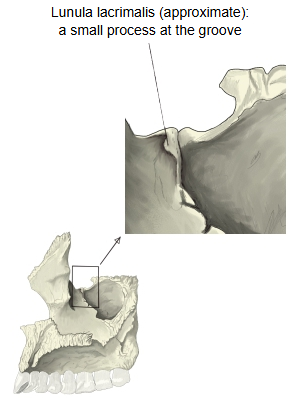
The lacrimal groove of the maxilla runs down on the nasal surface of the body of the maxilla, in front of and above the maxillary hiatus; together with the groove of the same name on the lacrimal bone it forms the bony nasolacrimal canal. The back edge of the lacrimal groove curls forward to form a small, thin, crescent-shaped process: the lunula lacrimalis. It arises from the front edge of the maxillary hiatus and makes the back wall of the groove higher. Sources differ on whether this small process is named at all; the position in the figure is approximate.
Related terms
- Lacrimal caruncle
- Lacrimal canaliculus
- Lacrimal passage
- Fossa for lacrimal gland
- Lacrimal groove of maxilla
- Lacrimal margin of maxilla
- Lacrimal notch
- Lacrimal process
- Lacrimal groove
- Maxillary hiatus
- Nasolacrimal canal
- Body of maxilla
- Maxilla
References and sources
- Further reading: Maxilla, Wikipedia.
- Further reading: Nasolacrimal canal, Wikipedia.
- Federative International Programme for Anatomical Terminology (FIPAT). Terminologia Anatomica, 2nd ed. (TA2), 2019.