Incisive bone (Latin: os incisivum)
Also called the premaxilla
· Also called the premaxilla.
· After fusing with the maxilla, it leaves its trace as the incisive suture, which may remain on the underside of the hard palate, running from the incisive fossa toward the space between the lateral incisor and the canine.
In the fetus, the front midline part of the bony palate is formed by this pair of small bones, which carry the upper incisors. Each fuses with the main part of the maxilla early in life; sources differ on the timing, but the fusion usually starts before birth and is complete in childhood. In many other vertebrates the bone stays separate throughout life and is called the premaxilla. Goethe is credited with showing that it is also present in humans, so it is sometimes called Goethe's bone.
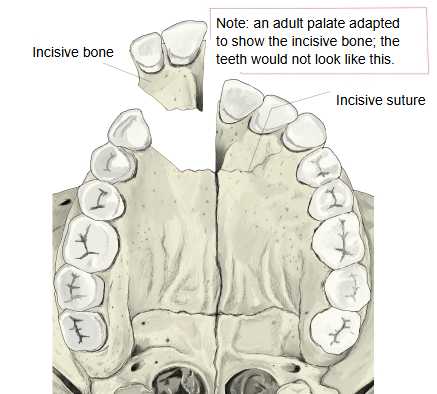
The incisive bone is not counted as a separate bone of the adult skull; it is part of the maxilla. Failure of fusion between this region and the rest of the maxilla is involved in cleft lip and cleft of the primary palate.
Reference websites
[Wikipedia]
· Incisive bone, Wikipedia.
· Premaxilla, Wikipedia.
[Websites with illustrations]
· Development of the maxilla by four centres (inferior surface) (Wikimedia Commons)

· The bony palate and alveolar arch (Wikimedia Commons)

Related terms
- Incisive fossa
- Incisive foramen
- Incisive papilla
- Incisive crest
- Median palatine suture
- Maxilla
- Incisor
- Hard palate
- Bony palate
- Incisive canal
- Palatine process
- Viscerocranium
References and sources
- Further reading: Incisive bone, Wikipedia.
- Further reading: Premaxilla, Wikipedia.
- Federative International Programme for Anatomical Terminology (FIPAT). Terminologia Anatomica, 2nd ed. (TA2), 2019.