Bony palate (Latin: palatum osseum)
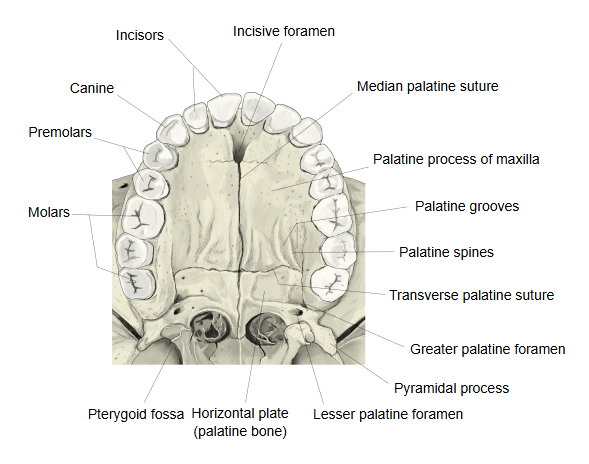
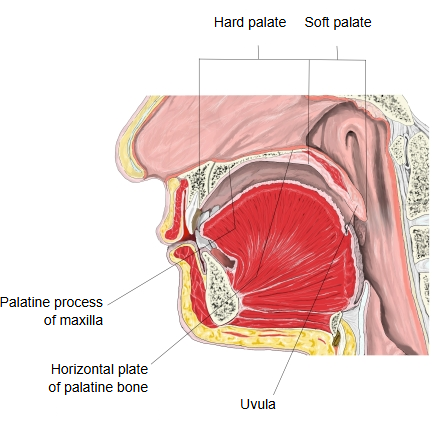
The bony palate is the part of the palate formed by bone: the palatine processes of the maxillae and the horizontal plates of the palatine bones.
Palate: the roof of the oral cavity= the hard palate (the front part of the palate) without its mucous membrane
It forms the roof of the mouth and the floor of the nasal cavity. The palatine processes of the two maxillae form the front part (about three-quarters) and the horizontal plates of the two palatine bones the back part. The four pieces meet at the median palatine suture and the transverse palatine suture, which together form a cross. Openings on its lower surface include the incisive foramen at the front and the greater and lesser palatine foramina near the back corners. It is bordered in front and at the sides by the alveolar processes of the maxillae, which hold the upper teeth, and the soft palate hangs from its free back edge.
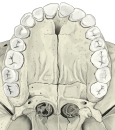 Bony palate (inferior view)
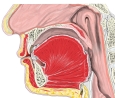 Oral cavity and pharynx (median section)
Related terms
- Hard palate
- Palate
- Palatine process
- Horizontal plate
- Transverse palatine suture
- Palatine bone
- Maxilla
References and sources
- Further reading: Hard palate, Wikipedia.
- Further reading: Palatine bone, Wikipedia.
- Federative International Programme for Anatomical Terminology (FIPAT). Terminologia Anatomica, 2nd ed. (TA2), 2019.