Angle of anteversion
Also called femoral anteversion or the angle of femoral torsion
The angle of anteversion is the angle by which the neck of the femur is twisted forward relative to the transverse axis of the femoral condyles, seen from above.
Femur: the thigh bone
The angle of anteversion becomes smaller with growth.
· Newborn: 15°–57° (mean 32°)
· 1–3 years: 20°–50° (mean 34°)
· Adult: mean 12°–15°
Sources differ in the exact ranges.
· Newborn: 15°–57° (mean 32°)
· 1–3 years: 20°–50° (mean 34°)
· Adult: mean 12°–15°
Sources differ in the exact ranges.
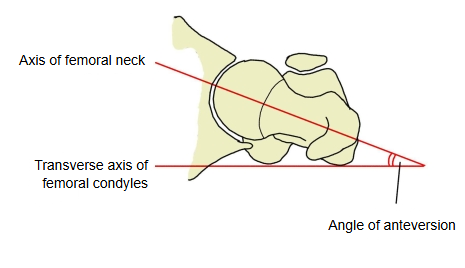
· Looked at from above, the axis of the neck and head of the femur does not lie in the same plane as the axis through the two condyles at the knee. The neck points forward (and medially), so the two axes form an angle. It is measured in the horizontal plane.
· A larger angle than normal (excess anteversion) tends to turn the knees and feet inwards when walking (in-toeing). A smaller or reversed angle (retroversion) tends to turn them outwards.
· It is different from the neck-shaft angle, which is measured in the frontal plane between the neck and the shaft of the femur.
Related terms
References and sources
- Further reading: Femur, Wikipedia.
- Further reading: Femoral neck, Wikipedia.
- Federative International Programme for Anatomical Terminology (FIPAT). Terminologia Anatomica, 2nd ed. (TA2), 2019.