Digital impressions (Latin: impressiones gyrorum)
Also called the impressions of cerebral gyri or the gyral impressions or the digital impression
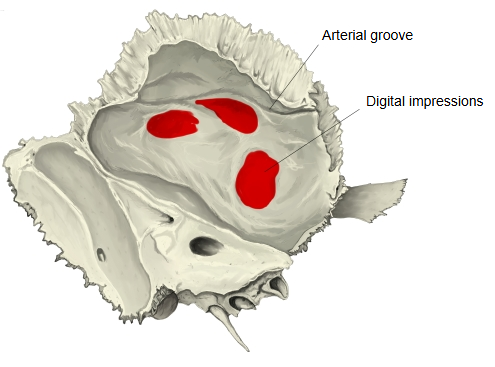
· Digital impressions are shallow, fingertip-like hollows on the inner surface of the neurocranium that match the convolutions (gyri) of the brain.
· Each hollow lies against a gyrus; the low ridges between them (cerebral juga) lie opposite the sulci of the brain.
· They are most marked near the cranial base (internal surface of the cranial base), in the anterior and middle cranial fossae, for example on the orbital part of the frontal bone and the inner surface of the squamous part of the temporal bone. They are faint on the roof of the skull (calvaria).
· They are clearer in children, while the brain grows quickly. On X-rays, unusually deep and widespread impressions (a 'copper-beaten' skull) can be a sign of raised pressure inside the skull.
Related terms
References and sources
- Further reading: Skull, Wikipedia.
- Federative International Programme for Anatomical Terminology (FIPAT). Terminologia Anatomica, 2nd ed. (TA2), 2019.