Internal cranial base (Latin: basis cranii interna)
Also called the floor of the cranial cavity
More details
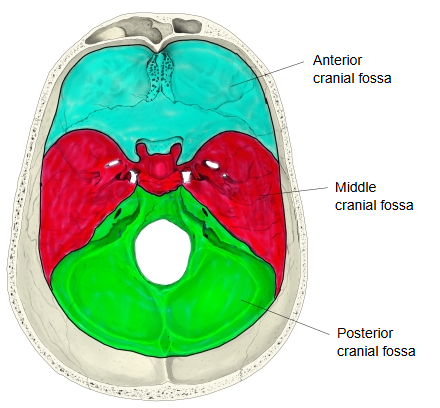
The cranial base can be divided into two surfaces, the inner internal cranial base and the outer external cranial base. The internal cranial base is further divided into three parts: the anterior, middle and posterior cranial fossae.
- Internal cranial base : cranial fossae: anterior, middle and posterior cranial fossa
- External cranial base : anterior, middle and posterior parts
The floor rises in three steps from back to front. Anterior cranial fossa: over the orbits and nasal cavity; it holds the frontal lobes. In the midline lies the cribriform plate for the olfactory nerves; its back edge is formed by the lesser wings of the sphenoid.
Middle cranial fossa: butterfly-shaped, with the sella turcica and its hypophysial fossa in the centre and deep lateral parts that hold the temporal lobes. Its back edge is the ridge of the petrous part of the temporal bone.
Posterior cranial fossa: the deepest; it holds the cerebellum, pons and medulla oblongata, and contains the foramen magnum, with the internal occipital crest and internal occipital protuberance behind it.
The internal cranial base is formed by the frontal, ethmoid, sphenoid, temporal and occipital bones, with a small part of the parietal bones at the back corners.
Related terms
- Internal occipital protuberance
- Internal occipital crest
- External cranial base
- Posterior cranial fossa
- Cribriform plate
- Sella turcica
- Hypophysial fossa
- Foramen magnum
References and sources
- Further reading: Base of skull, Wikipedia.
- Federative International Programme for Anatomical Terminology (FIPAT). Terminologia Anatomica, 2nd ed. (TA2), 2019.