Axis of lens (Latin: axis lentis)
The axis of the lens is the line that joins the anterior pole on the front and the posterior pole on the back of the lens.
Lens: a transparent body shaped like a biconvex lens
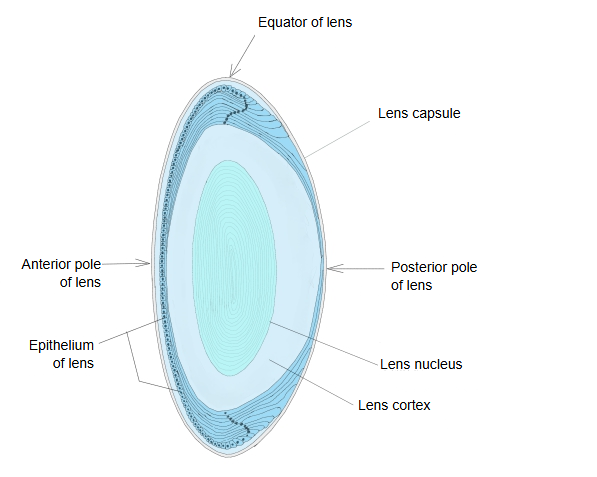
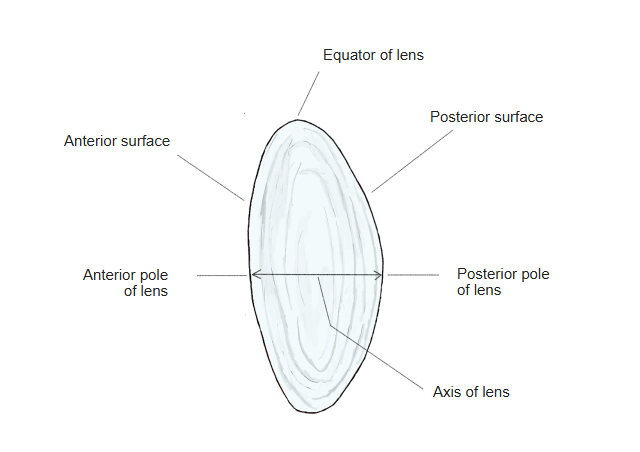
The axis of the lens is an imaginary straight line. Its length is the thickness of the lens: about 4 mm in the adult (roughly 3.5-5 mm). It lies on the optic axis of the eyeball, at right angles to the plane of the equator of the lens. When the ciliary muscle of the ciliary body contracts for near vision, the ciliary zonule slackens, the lens rounds up and the axis becomes longer. The lens keeps growing throughout life, so the axis slowly lengthens with age.
Related terms
- Lens nucleus
- Lens cortex
- Posterior pole of lens
- Equator of lens
- Radii of lens
- Lens
- Eyeball
- Internal axis of eyeball
- External axis of eyeball
- Ciliary zonule
- Ciliary body
References and sources
- Further reading: Lens (vertebrate anatomy), Wikipedia.
- Federative International Programme for Anatomical Terminology (FIPAT). Terminologia Anatomica, 2nd ed. (TA2), 2019.