Juxtaglomerular apparatus
Also called the juxtaglomerular complex
Overview
Components
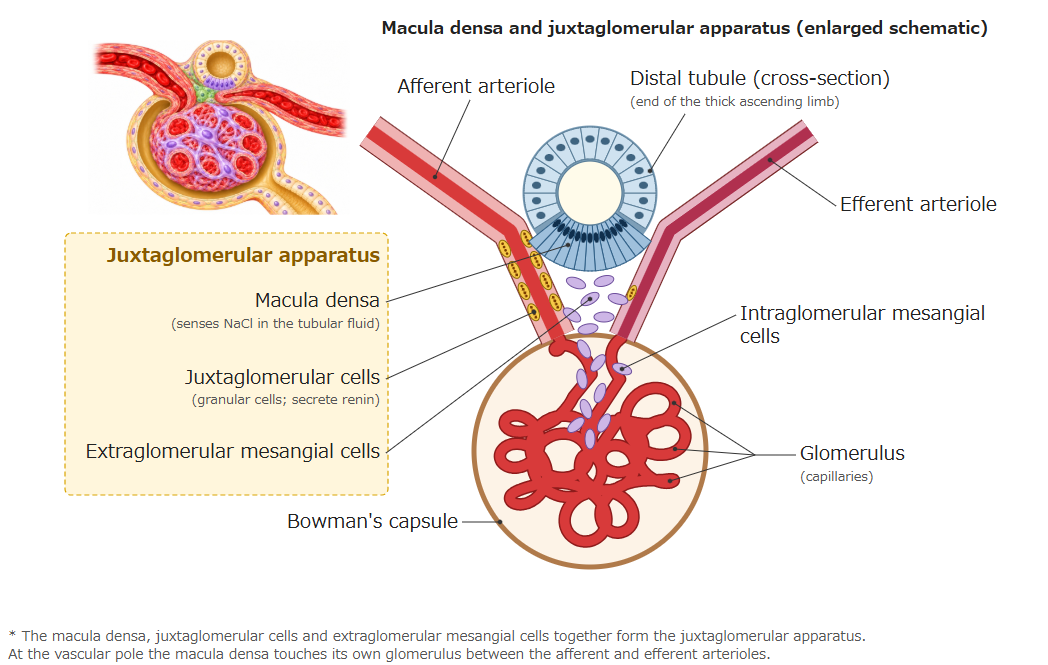
- Macula densa : in the wall of the distal tubule (end of the thick ascending limb); senses the NaCl concentration.
- Juxtaglomerular cells : in the wall of the afferent arteriole (a few in the efferent arteriole); secrete renin.
- Extraglomerular mesangial cells : between the macula densa and the afferent and efferent arterioles; pass on the signals.
· The juxtaglomerular apparatus (juxtaglomerular complex) is a structure found in every nephron, beside the glomerulus, where the afferent arteriole and the distal tubule meet. It regulates the work of that nephron.
· It lies near the vascular pole, between the afferent arteriole and the distal tubule of the same nephron (the end of the thick ascending limb).
· It is made of three cell types: the macula densa in the wall of the distal tubule, the renin-secreting juxtaglomerular cells (granular cells) in the wall of the afferent arteriole, and the extraglomerular mesangial cells between them.
· The basal sides of the macula densa cells are in close contact with the extraglomerular mesangial cells and the juxtaglomerular cells.
· The macula densa senses the NaCl concentration of the fluid in the renal tubule, and this information is passed on to make the afferent arteriole constrict or relax (tubuloglomerular feedback), which keeps the glomerular filtration rate and renal blood flow steady, and to change the release of renin by the juxtaglomerular cells.
· The release of renin drives the renin-angiotensin-aldosterone system and so takes part in the control of blood pressure and body fluid volume.
How the juxtaglomerular apparatus works
In the feedback, when the filtration rate falls the afferent arteriole widens instead, and the rate comes back up.
Reference websites
[Wikipedia]
· Juxtaglomerular apparatus, Wikipedia.
· Tubuloglomerular feedback, Wikipedia.
· Macula densa, Wikipedia.
[Websites with illustrations]
· Tubules and collecting system (8) (Digital Histology)
· Juxtaglomerular apparatus (micrograph) (SIU School of Medicine histology)
· Macula densa (micrograph) (SIU School of Medicine histology)
· Juxtaglomerular apparatus (Kenhub)
Related terms
- Juxtaglomerular cells
- Macula densa
- Vascular pole
- Distal tubule
- Kidney
- Renal artery
- Interlobular arteries of kidney (cortical radiate arteries)
- Renal parenchyma
- Urinary system
References and sources
- Further reading: Juxtaglomerular apparatus, Wikipedia.
- Further reading: Tubuloglomerular feedback, Wikipedia.
- Further reading: Macula densa, Wikipedia.
- Federative International Programme for Anatomical Terminology (FIPAT). Terminologia Anatomica, 2nd ed. (TA2), 2019.