Sphenooccipital synchondrosis (Latin: synchondrosis sphenooccipitalis)
Also called the spheno-occipital synchondrosis
Cartilaginous joints are divided into two kinds by the type of cartilage that joins the bones.
- Hyaline cartilage joint : = synchondrosis. The bones are joined by hyaline cartilage, which tends to turn to bone with age. Examples: the epiphyseal plates, the joint of the first costal cartilage with the sternum (sternal synchondroses), and the sphenooccipital synchondrosis. In many texts a cartilaginous joint in the narrow sense means this kind.
- Fibrocartilage joint : = symphysis. The bones are joined by fibrocartilage. Examples: the pubic symphysis, the intervertebral joints and the manubriosternal joint.
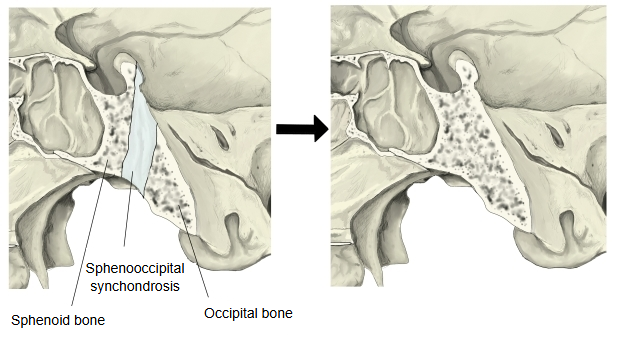
It is the cartilaginous union between the body of the sphenoid and the basilar part of the occipital bone, a primary cartilaginous joint (synchondrosis). It is not a suture, although it is sometimes wrongly called the sphenooccipital suture. It ossifies after puberty, usually by the late teens or early twenties (the exact age varies between individuals and sources); because its state of fusion helps to estimate age, it is important in forensic anthropology.
It is an important growth site of the cranial base: while it is cartilage it lets the cranial base lengthen, especially the clivus, during childhood. After fusion the sphenoid bone and the occipital bone form one continuous bar of bone, the clivus.
Related terms
- Sphenoidal rostrum
- Jugum sphenoidale
- Sphenoidal crest
- Sphenoidal emissary foramen
- Sphenopalatine notch
- Sphenoparietal suture
- Cartilaginous joint
- Sternal synchondroses
- Clivus
- Body of sphenoid
- Occipital bone
- Sphenoid bone
References and sources
- Further reading: Clivus, Wikipedia.
- Further reading: Synchondrosis, Wikipedia.
- Federative International Programme for Anatomical Terminology (FIPAT). Terminologia Anatomica, 2nd ed. (TA2), 2019.