Sphenoidal rostrum (Latin: rostrum sphenoidale)
Also called the rostrum of sphenoid
The sphenoidal rostrum is the small triangular spine, pointing forwards, in the midline of the under surface of the body of the sphenoid; in front it is continuous with the lower end of the sphenoidal crest, the ridge that runs vertically down the middle of the front surface of the body.
Body of the sphenoid: the central part of the sphenoid bone, without its wings and processes
- Superior surface : faces the cranial cavity and forms the central part of the cranial fossae. Neighbours: the ethmoid bone in front; behind, the dorsum sellae forms the clivus with the basilar part of the occipital bone. Features: sella turcica, hypophysial fossa, tuberculum sellae, dorsum sellae, middle clinoid process, posterior clinoid process, chiasmatic sulcus, carotid sulcus, lingula of the sphenoid.
- Inferior surface : forms the roof of the pharynx. Neighbour: the vomer. Feature: sphenoidal rostrum.
- Anterior surface : faces the nasal cavity. Neighbour: the ethmoid bone. Features: sphenoidal crest (continuing below into the sphenoidal rostrum), sphenoidal conchae (with the aperture of the sphenoidal sinus).
- Posterior surface : a rough, four-sided surface. Neighbour: the occipital bone.
It is received between the alae of the vomer and forms the root of the nasal septum.
Ala of the vomer: each of the two parts of the upper border of the vomer that spread to the left and right
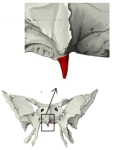 Sphenoid bone (anterior)
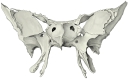 Sphenoid bone (anterior)
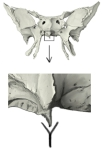 Junction with the alae of vomer
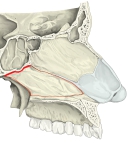 Nasal septum
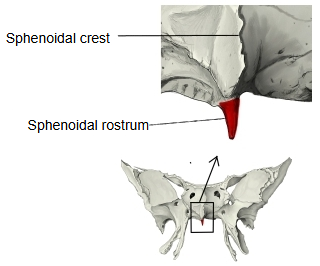
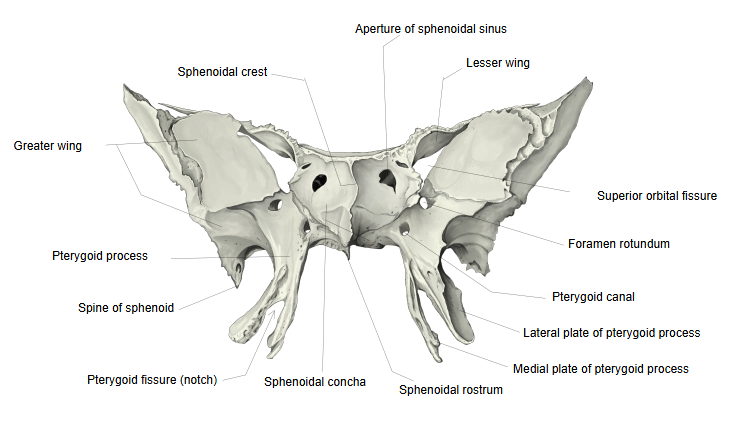
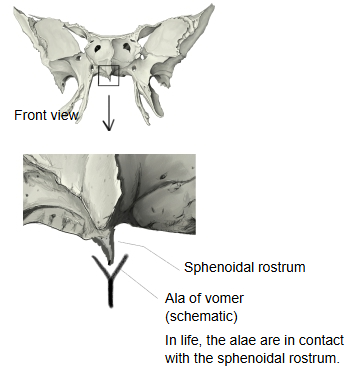
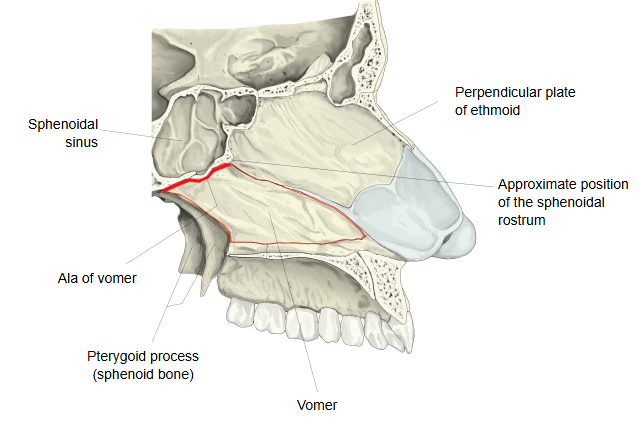
On the under surface of the body, in the midline, the rostrum forms a small triangular spine continuous in front with the sphenoidal crest. It fits into the deep groove between the two alae of the vomer, fixing the upper border of the vomer to the sphenoid, and so forms a small part of the back of the nasal septum, below the openings of the sphenoidal sinuses.
Reference websites
[Wikipedia]
· Sphenoid bone, Wikipedia.
[Websites with illustrations]
· Sphenoid bone, anterior and inferior surfaces (Gray's Anatomy) (Wikimedia Commons)

· Sphenoid bone (ClipArt ETC, University of South Florida)

Related terms
- Jugum sphenoidale
- Sphenoidal crest
- Sphenoidal emissary foramen
- Sphenopalatine notch
- Sphenooccipital synchondrosis
- Sphenoparietal suture
- Sphenoid bone
- Body of sphenoid
- Ala of vomer
- Vomer
- Nasal septum
- Sphenoidal sinus
References and sources
- Further reading: Sphenoid bone, Wikipedia.
- Federative International Programme for Anatomical Terminology (FIPAT). Terminologia Anatomica, 2nd ed. (TA2), 2019.