Rectosacral fascia (Latin: fascia rectosacralis)
Also called Waldeyer's fascia (in surgical use)
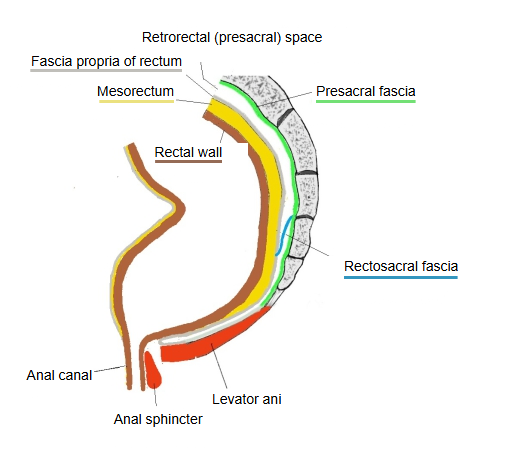
· The rectosacral fascia is a thick, tough band of fascia in the space behind the rectum (the retrorectal space). It arises from the presacral fascia, which covers the front of the sacrum, and runs downward and forward to join the fascia propria of the rectum, which wraps the rectum.
· In this way the mesorectum and the rectum are tied to the presacral fascia and the sacrum. It is not listed as a separate structure in the standard anatomical terminology; the name comes mainly from surgical anatomy.
Position
· It arises from the presacral fascia at the level of the 2nd to 4th sacral vertebrae, most often at the 4th (S4).
· It runs downward and joins the fascia propria of the rectum about 3–5 cm above the junction of the rectum and the anal canal (the anorectal junction).
· It divides the retrorectal space into an upper and a lower part.
· In a dissection study of 15 specimens (García-Armengol and colleagues, 2008), the rectosacral fascia divided the retrorectal space into upper and lower parts in 80% of the male and all of the female pelves. It arose from the presacral fascia at S2 in 15%, at S3 in 38% and at S4 in 46% of specimens, and in every case it joined the fascia of the rectum 3–5 cm above the anorectal junction.
About the name
· Surgeons often call this fascia Waldeyer's fascia.
· However, some authors point out that what Waldeyer originally described was the place where the presacral fascia and the fascia propria of the rectum fuse at the floor of the retrorectal space (above the levator ani, at the level of the anorectal junction), and that this should be kept separate from the rectosacral fascia (García-Armengol and colleagues, 2008). Others use the name for the presacral fascia itself, so the use of the eponym is not consistent. Sources also differ on its level, on how constant it is, and on whether it is a separate layer or a thickening where the two fasciae meet.
Clinical significance
· In surgery for rectal cancer (total mesorectal excision, TME), the dissection proceeds from above between the fascia propria of the rectum and the presacral fascia, and meets sudden resistance at the level of this fascia.
· Tearing it bluntly with a finger or an instrument can rip the presacral fascia and cause heavy bleeding from the presacral (sacral) venous plexus behind it, or else damage the mesorectum. It is therefore divided sharply with diathermy or scissors before the dissection continues downward.
More details
· See "Retrorectal space", "Presacral fascia", "Fascia propria of rectum" and "Mesorectum".
Reference websites
[Wikipedia]
· Total mesorectal excision, Wikipedia.
· Pelvic fascia, Wikipedia.
[Websites with illustrations]
· Rectosacral fascia (IMAIOS e-Anatomy)
· Fasciae and spaces around the rectum (median section) (Springer)

· Fascia propria, rectosacral and presacral fasciae (Obgyn Key)

· Presacral, mesorectal and rectosacral fasciae (median section) (IntechOpen)

Related terms
- Retrorectal space
- Fascia propria of rectum
- Transverse folds of rectum
- Rectococcygeus
- Presacral fascia
- Presacral space
- Mesorectum
- Rectum
- Sacrum
- Parietal pelvic fascia
- Sacral venous plexus
References and sources
- Further reading: Total mesorectal excision, Wikipedia.
- Further reading: Pelvic fascia, Wikipedia.
- Federative International Programme for Anatomical Terminology (FIPAT). Terminologia Anatomica, 2nd ed. (TA2), 2019.