Groove for aorta
Also called Aortic groove (of lung) or the aortic impression
On the left lung a broad groove arches over the hilum and runs down behind the pulmonary ligament. This is the groove for aorta, made by the aortic arch and the thoracic aorta.
At the lowest end of this groove there is an impression made by the esophagus, called the groove for esophagus.
The right lung has no aortic groove; there the groove for superior vena cava runs down from the apex to the front of the hilum.
· Above, the groove is continuous with the groove for the subclavian artery on the apex of the lung.
· Like the other grooves on the medial surface, it is clear on lungs hardened in place; the living lung only moulds against the aorta.
 Left lung (medial surface)
 Left lung with nearby vessels (medial view)
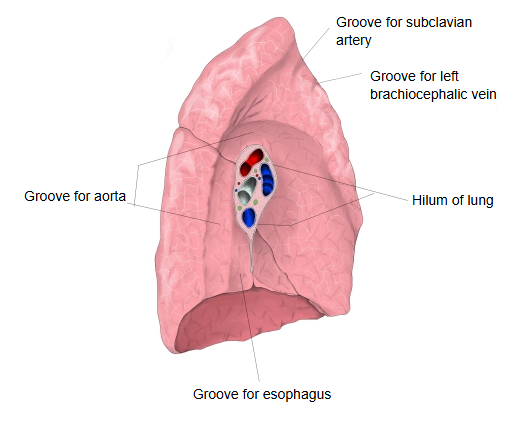
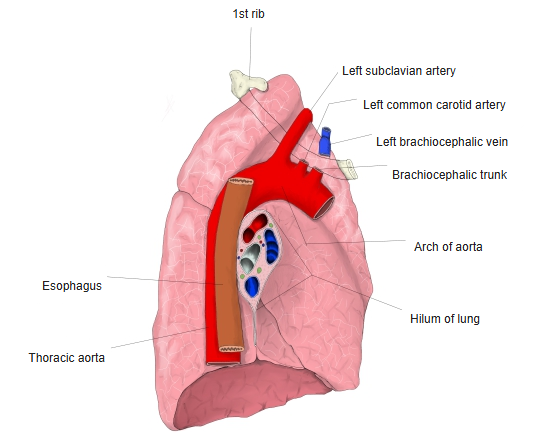
Reference websites
[Wikipedia]
· Lung, Wikipedia.
[Websites with illustrations]
· Medial surface of the lungs (textbook figure) (Jaypee Digital)

· Mediastinal surface of the left lung (textbook figure) (Jaypee Digital)

Related terms
- Groove for esophagus
- Groove for subclavian artery
- Groove for superior vena cava
- Cardiac impression
- Root of lung
- Lung
- Thoracic aorta
References and sources
- Further reading: Lung, Wikipedia.
- Federative International Programme for Anatomical Terminology (FIPAT). Terminologia Anatomica, 2nd ed. (TA2), 2019.