Intervertebral disc (Latin: discus intervertebralis)
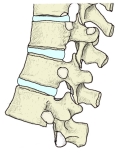
A round plate of fibrocartilage between the bodies of neighbouring vertebrae of the vertebral column; it absorbs shocks on the vertebrae and allows the column to move. The discs join the vertebral bodies in cartilaginous joints (symphyses).
The intervertebral disc is made of fibrocartilage, one of the three kinds of cartilage (hyaline, elastic and fibrocartilage).
Number
· There is no intervertebral disc between the atlas and the axis.
(The discs lie between the bodies of the vertebrae, and the atlas has no vertebral body.)
· The lowest disc lies between the fifth lumbar vertebra and the sacrum.
Structure
It has two main parts.
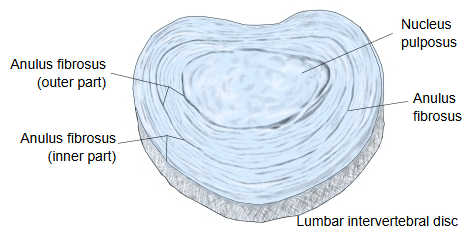
| 1 | Nucleus pulposus | The soft, gel-like centre of the disc, lying slightly behind the middle and touching the layer of hyaline cartilage that covers the vertebral bodies. It is mostly water (roughly 70–90%, less with age) held by proteoglycans, and acts as a fluid cushion: it takes up the pressure along the column and spreads it evenly onto the anulus and the vertebral bodies. |
| 2 | Anulus fibrosus | The tough outer ring, in two parts. Inner part: fibrocartilage rich in type II collagen that blends with the hyaline cartilage covering the vertebral bodies. Outer part: concentric layers (lamellae) of dense fibrous tissue rich in type I collagen, very strong in tension. Its fibres run obliquely, in alternating directions from one layer to the next, so that they cross each other; they are attached to the rims of the vertebrae above and below and to the anterior and posterior longitudinal ligaments. The nucleus can bulge or escape through a tear in the anulus (disc herniation), most often towards the back and side, where it can press on a spinal nerve. |
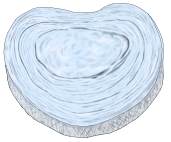 Lumbar intervertebral disc
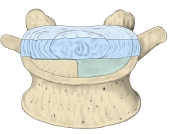 Lumbar disc (coronal section)
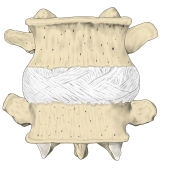 Disc between L3 and L4
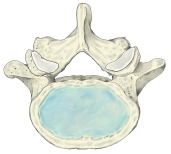 5th lumbar vertebra, upper surface
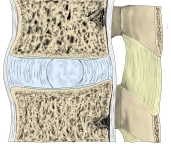 Disc in sagittal section
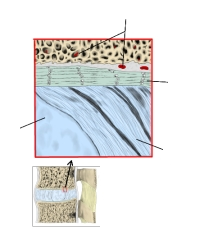 Disc and endplate (detail)
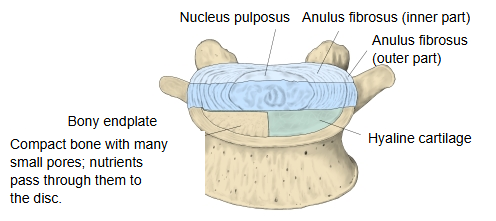
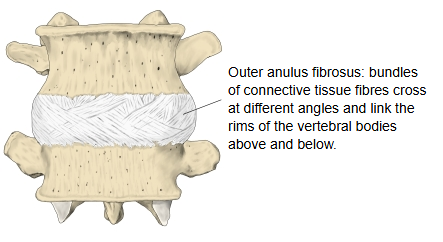
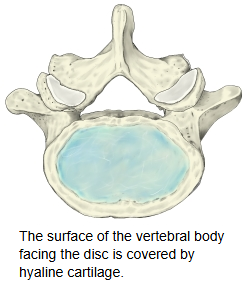
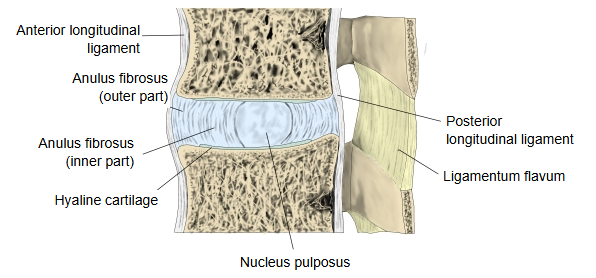
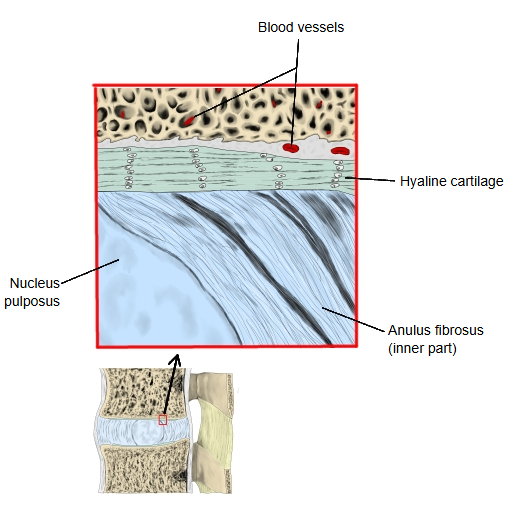
Endplates: the upper and lower surfaces of each vertebral body facing the disc are covered by a thin layer of hyaline cartilage. The bony surface beneath has many small pores; the adult disc has almost no blood vessels of its own and is nourished by diffusion through the endplates.
Shape and size
Each disc matches the shape of the vertebral bodies it joins, so its shape differs from region to region.
The vertebral bodies themselves get larger further down the column.
The discs are thinnest in the upper thoracic region and thickest in the lumbar region; a thicker disc allows more movement. In the cervical and lumbar regions the discs are thicker in front than behind, which helps form the forward curves of these regions; this is most marked in the disc between the fifth lumbar vertebra and the sacrum.
Together the discs make up about a quarter of the length of the vertebral column above the sacrum.
Related terms
- Vertebra
- Intervertebral foramen
- Intervertebral symphysis
- Lumbosacral joint
- Vertebral body
- Vertebral column
- Cartilaginous joint
- Anterior longitudinal ligament
- Posterior longitudinal ligament
- Ligamenta flava
- Lumbar vertebrae
References and sources
- Further reading: Intervertebral disc, Wikipedia.
- Further reading: Spinal disc herniation, Wikipedia.
- Federative International Programme for Anatomical Terminology (FIPAT). Terminologia Anatomica, 2nd ed. (TA2), 2019.