Pyloric orifice (Latin: ostium pyloricum)
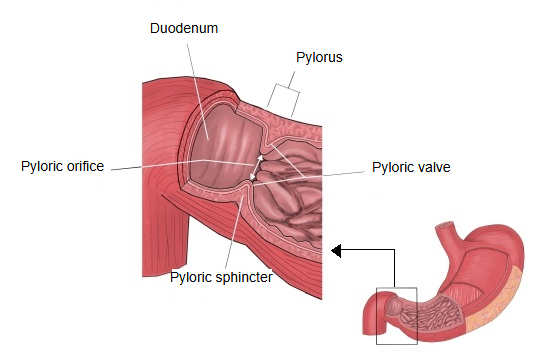
The pyloric orifice is the small opening in the pylorus (the end of the stomach) that is bounded by the free edge of the pyloric valve.
Its size changes as the valve opens and closes
· Through it the stomach communicates with the duodenum (its first part, the duodenal bulb). It is surrounded by the pyloric sphincter.
· Its size is not fixed: it widens when the sphincter relaxes to let chyme pass, and almost closes when the sphincter contracts.
· It usually lies at about the level of the first lumbar vertebra (the transpyloric plane), slightly to the right of the midline, and moves with posture and with filling of the stomach.
Parts
of the
stomach
of the
stomach
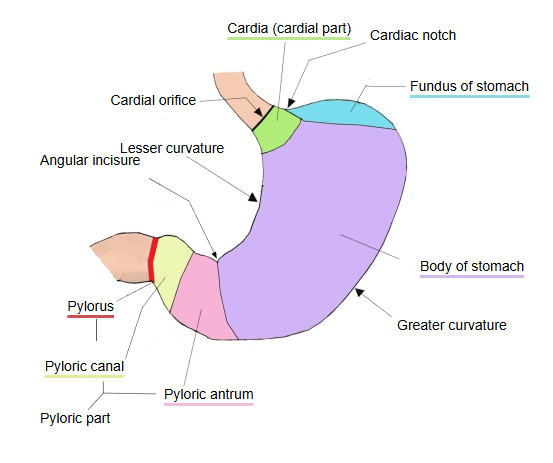
- Cardia : the area round the upper opening, where the oesophagus joins (cardial orifice, cardiac notch).
- Body : the large main part in the middle (with the gastric canal along the lesser curvature).
- Fundus : the part that bulges up and to the left of the body.
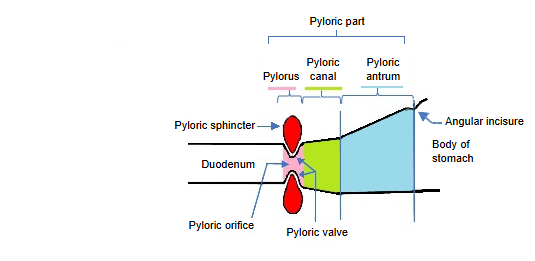
- Pyloric part : the area round the lower opening, leading to the duodenum.
- Pylorus : the end of the stomach, at the junction with the duodenum: pyloric valve, pyloric sphincter, pyloric orifice.
- Pyloric canal : the last 2-3 cm of the stomach before the pylorus.
- Pyloric antrum : the wider part before the pyloric canal, bounded above by the angular incisure, where it meets the body.
Reference websites
[Wikipedia]
· Pylorus, Wikipedia.
· Stomach, Wikipedia.
[Websites with illustrations]
· Stomach (Kenhub)
· The stomach (TeachMeAnatomy)
· Interior of the stomach (Gray's Anatomy) (Wikimedia Commons)

Related terms
References and sources
- Further reading: Pylorus, Wikipedia.
- Federative International Programme for Anatomical Terminology (FIPAT). Terminologia Anatomica, 2nd ed. (TA2), 2019.