Gastric juice (Latin: succus gastricus)
Overview
Gastric juice is one of the digestive juices, secreted by the gastric glands in the lamina propria of the mucosa of the stomach.
Digestive juice: a fluid that breaks down food so that it can be absorbedGastric glands: the proper gastric glands of the fundus and body, with the cardiac and pyloric glands (mainly mucus); they open into the gastric pits
Gastric juice is strongly acidic (pH about 1-2); about 1.5-2.5 L is secreted each day (sources differ).
It plays an important part in digestion and in killing microbes
| Site | Juice | Carbohydrate-digesting | Protein-digesting | Fat-digesting and other |
|---|---|---|---|---|
| Oral cavity | Saliva | Amylase | - | - |
| Oesophagus | (none) | - | - | - |
| Stomach | Gastric juice | - | Pepsin | Gastric acid (turns pepsinogen into pepsin) |
| Small intestine | Bile | - | - | No enzymes; helps the digestion of fat |
| Pancreatic juice | Amylase | Trypsin, chymotrypsin, elastase, carboxypeptidase | Lipase, phospholipase; nucleic-acid-digesting enzymes | |
| Intestinal juice / intestinal wall | Maltase, isomaltase, lactase, sucrase, trehalase | Aminopeptidase | Nucleic-acid-digesting enzymes and others | |
| Large intestine | (none) | - | - | Absorbs water ⇒ faeces |
Digestive
juices
juices
- Saliva : where: oral cavity; contents: amylase, lipase and others; action: digestion of carbohydrates.
- Gastric juice : where: stomach; contents: hydrochloric acid, pepsin; action: digestion of protein, killing microbes.
- Pancreatic juice : where: pancreas; contents: amylase, lipase and others; action: digestion of all three main nutrients.
- Bile : where: liver; contents: bile acids, bilirubin and others; action: helps the digestion of fat.
- Intestinal juice : where: small intestine; contents: peptidases, maltase and others; action: last stage of digestion, helps absorption.
Components
| Component | Secreted by | Main action | |
|---|---|---|---|
| 1 | Hydrochloric acid | Parietal cells | Lowers the pH, activates pepsinogen and kills many microbes |
| 2 | Pepsinogen | Chief cells | Enzyme precursor; turned by the acid into pepsin, which starts the digestion of protein |
| 3 | Intrinsic factor | Parietal cells | Needed for the absorption of vitamin B12 (in the ileum) |
| 4 | Mucus | Mucous cells (surface mucous cells and mucous neck cells) | Protects the gastric mucosa from acid and digestive enzymes |
| 5 | Bicarbonate | Mucous cells | Neutralizes the acid at the surface of the gastric mucosa |
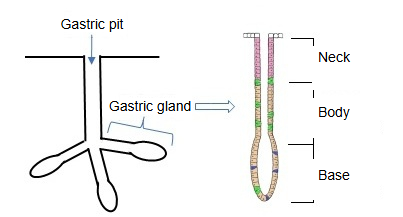
From the gastric glands to pepsin
Gastric glandsproper gastric glands
Pepsinogenprecursor of pepsin
+ gastric acid (from parietal cells)
Pepsinprotein-digesting enzyme
The proper gastric glands make up most of the fundus and body; usually 3-4 open into the bottom of each gastric pit, and each has a neck, a body and a base.
Actions
· Starts the digestion of protein (breakdown by pepsin).
· Kills microbes (most microorganisms taken in with food).
· Prepares vitamin B12 for absorption (intrinsic factor).
· Protects the gastric mucosa (mucus + bicarbonate).
Related terms
- Secretion
- Exocrine secretion
- Stomach
- Gastric pits
- Gastric areas
- Gastric folds
- Exocrine gland
- Salivary glands
- Pancreas
References and sources
- Further reading: Gastric acid, Wikipedia.
- Further reading: Gastric glands, Wikipedia.
- Federative International Programme for Anatomical Terminology (FIPAT). Terminologia Anatomica, 2nd ed. (TA2), 2019.