Germinal center (Latin: centrum germinale)
Also called the germinal centre or the reaction centre
- Overview
- Structure
- Cells of the germinal centre
- Functions
- Reference websites
- (Wikipedia, websites with illustrations)
- Related terms
Overview
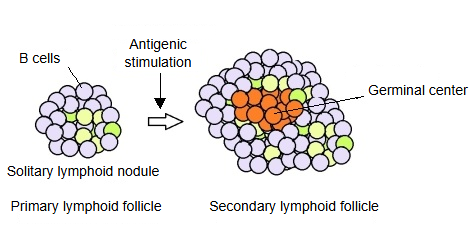
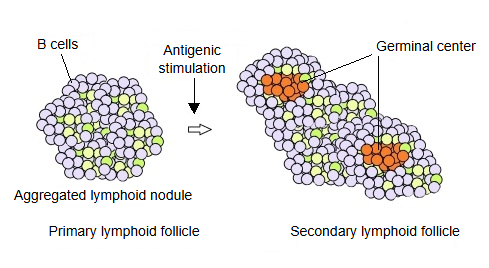
· Germinal centres are found only in secondary lymphoid nodules, that is, nodules that have been activated by antigenic stimulation. A resting (primary) nodule has none.
Structure
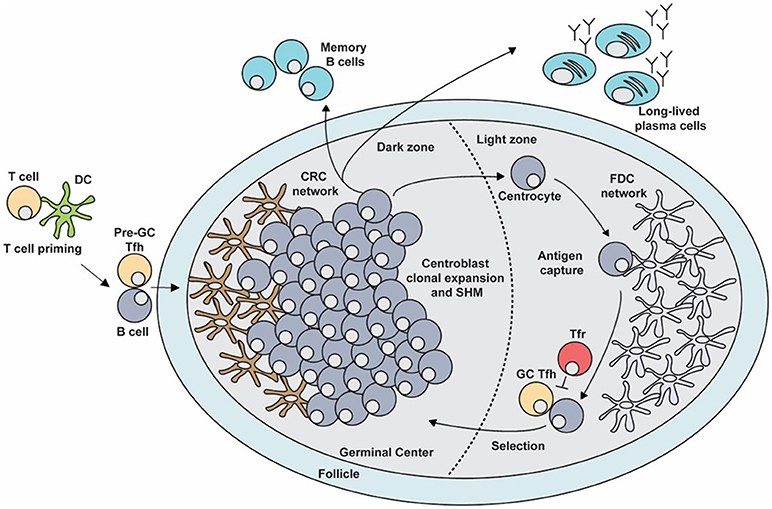
A germinal centre can be divided into two parts.
| Part | Features | Main cells | |
|---|---|---|---|
| 1 | Dark zone | B cells are dividing rapidly; it looks dark because the cells are densely packed. | Centroblasts |
| 2 | Light zone | The B cells that have divided are tested (selected) against the antigen; it looks paler because the cells are less crowded. | Centrocytes, follicular dendritic cells (FDC) |
· Around it lies a layer called the mantle zone, a darker cap of small, resting (naive) B cells that have not yet met the antigen.
Cells of the germinal centre
The germinal centre is where B cells divide and differentiate actively, but not all of its cells are B cells. The table shows the kinds of cells and their rough shares.
| Cell | Role | Share (approx.) | |
|---|---|---|---|
| 1 | Centroblasts / centrocytes (B cells) | Multiplication, mutation, selection | 70–90% |
| 2 | Follicular dendritic cells | Hold antigen on their surface; support the selection of B cells | 5–10% (few cells, but a dense network) |
| 3 | Follicular helper T cells | Give B cells signals (antibody class switching, survival) | 5–10% |
| 4 | Tingible body macrophages | Take up B cells that have died by apoptosis | 1–5% |
| 5 | Others (reticular (stromal) cells, endothelial cells, etc.) | Support the structure; connection with the blood and lymphatic vessels | small numbers |
Functions
In the germinal centre the following take place:
1. 1. Clonal expansion: B cells that recognise the antigen multiply.
2. 2. Affinity maturation: B cells whose antibodies bind the antigen more strongly are selected, so that better antibodies are made.
3. 3. Class switching: for example from IgM to IgG.
4. 4. Differentiation into antibody-secreting plasma cells and long-lived memory B cells.
⇒ In short, the germinal centre is where B cells develop into "better antibody-producing cells". Germinal centres occur in the lymph nodes, the spleen, the tonsils and the lymphoid nodules of mucous membranes.
Reference websites
[Wikipedia]
· Germinal center, Wikipedia.
[Websites with illustrations]
· Formation of a germinal centre in a follicle, day by day (figure) (Nature Reviews Immunology)

· Germinal center (diagram) (Wikimedia Commons)

· Dark zone and light zone of the germinal centre (figure) (Frontiers in Immunology)
Related terms
- Lymphoid nodule
- Primary lymphoid follicle
- B lymphocyte
- Aggregated lymphoid nodules
- Lymph node
- Tonsil
- Spleen
References and sources
- Further reading: Germinal center, Wikipedia.
- Further reading: Lymphoid follicle, Wikipedia.
- Federative International Programme for Anatomical Terminology (FIPAT). Terminologia Anatomica, 2nd ed. (TA2), 2019.