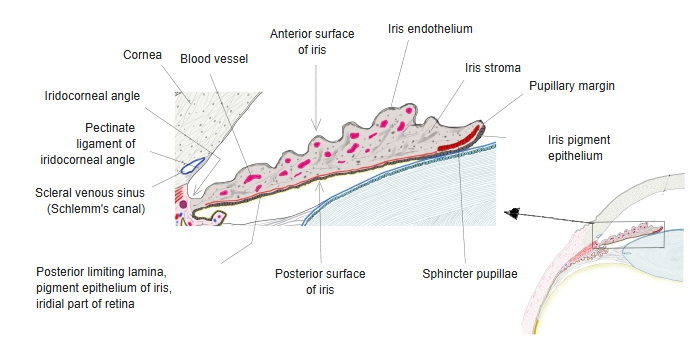
Stroma of iris (Latin: stroma iridis)
Also called the iris stroma
The stroma of the iris is one of the layers that make up the iris and forms most of it; some sources describe the iris as having five layers.
Iris: part of the vascular layer of the eyeball; it adjusts the size of the pupil
Layers
of the
iris
of the
iris
- Iris endothelium : described as a layer of flattened cells continuing the corneal endothelium (the endothelium of the anterior chamber); in the adult human iris it is not a continuous layer
- Stroma of iris
- Anterior border layer : fairly dense connective tissue with pigment cells
- Vascular layer : the main part of the iris, rich in vessels and nerves; it contains the sphincter pupillae (the dilator pupillae lies at its back)
- Posterior limiting lamina
- Behind it : the pigmented epithelium of the iris, which belongs to the inner layer of the eyeball (the iridial part of the retina)
The stroma is the loose, vascular connective tissue in front of the pigmented epithelium. It holds the vessels and nerves of the iris and the sphincter pupillae. Sources differ in where they draw its limits: some include the anterior border layer and the posterior limiting lamina in the stroma, while many English texts divide the whole iris simply into a stroma and a pigmented epithelium. See also Vascular layer of iris.
The table above follows one source; the layers of the iris are described differently in different sources.
Wikipedia, for example, divides the iris broadly into two layers: the stroma and the pigmented epithelial cells.