Pancreatic juice (Latin: succus pancreaticus)
juices
- Saliva : where: oral cavity (salivary glands); contents: amylase, lipase and others; action: digestion of carbohydrates.
- Gastric juice : where: stomach; contents: hydrochloric acid, pepsin; action: digestion of protein, killing microbes.
- Pancreatic juice : where: pancreas, into the duodenum; contents: amylase, lipase and others, and bicarbonate; action: digestion of all three main nutrients (carbohydrates, proteins and fats).
- Bile : where: liver; contents: bile acids, bilirubin and others; action: helps the digestion of fat.
- Intestinal juice : where: small intestine; contents: peptidases, maltase and others; action: last stage of digestion, helps absorption.
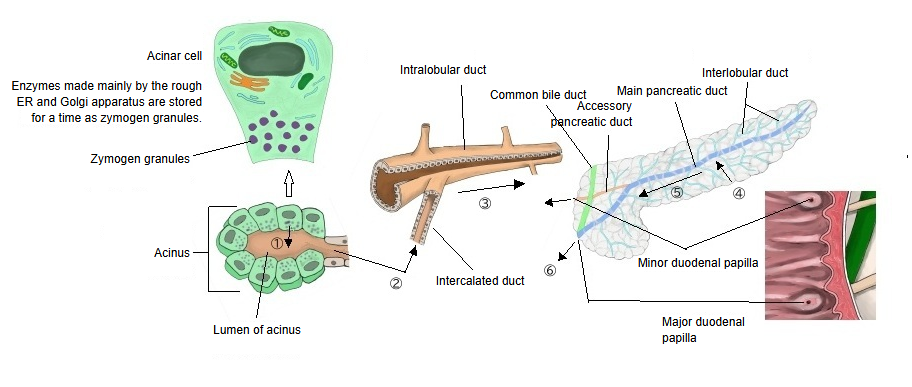
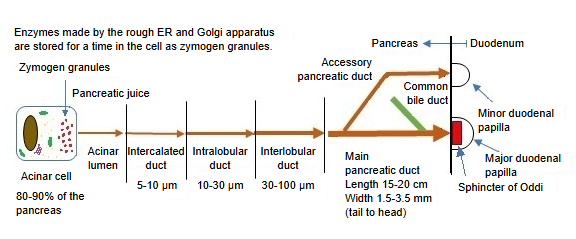
· After a meal it flows from the acini through the intercalated, intralobular and interlobular ducts into the pancreatic ducts and out into the duodenum.
· The amount secreted is given as about 0.5–0.8 L a day in some sources and about 1–1.5 L in others. It is weakly alkaline (pH about 7.5–8.5), and its bicarbonate neutralizes the acid chyme coming from the stomach.
| Site | Juice | Carbohydrate-digesting | Protein-digesting | Fat-digesting and other |
|---|---|---|---|---|
| Oral cavity | Saliva | Amylase | - | - |
| Oesophagus | (none) | - | - | - |
| Stomach | Gastric juice | - | Pepsin | Gastric acid (turns pepsinogen into pepsin) |
| Small intestine | Bile | - | - | No enzymes; helps the digestion of fat |
| Pancreatic juice | Amylase | Trypsin, chymotrypsin, elastase, carboxypeptidase | Lipase, phospholipase; nucleic-acid-digesting enzymes | |
| Intestinal juice / intestinal wall | Maltase, isomaltase, lactase, sucrase, trehalase | Aminopeptidase | Nucleic-acid-digesting enzymes and others | |
| Large intestine | (none) | - | - | Absorbs water ⇒ faeces |
· When acid contents of the stomach are pushed into the duodenum, the acid stimulates the mucosa to release the local hormone secretin,
which brings a large flow of secreted pancreatic juice rich in water and bicarbonate. Products of fat and protein digestion release cholecystokinin, which brings a juice rich in enzymes.
Digestive enzymes in pancreatic juice
| Name | Notes | |
|---|---|---|
| 1 | Amylase (pancreatic amylase) | Splits starch into maltose (a disaccharide) and other short sugar chains. Maltase, which splits maltose into glucose, is on the wall (brush border) of the small intestine. Amylase is also a digestive enzyme of the saliva secreted by the salivary glands. |
| 2 | Lipase (pancreatic lipase, with colipase) | Splits fat, after it has been emulsified by bile, into fatty acids and monoglycerides. Phospholipase A2 acts on phospholipids. |
| 3 | Trypsin, chymotrypsin (and elastase) | Digest proteins (and peptones). They are secreted as inactive precursors (trypsinogen, chymotrypsinogen, proelastase). Trypsinogen is activated in the duodenum by enteropeptidase (enterokinase) of the intestinal mucosa, and trypsin then activates the other precursors. |
| 4 | Carboxypeptidases | Secreted by the pancreas as precursors (procarboxypeptidases), which are activated in the duodenum (by trypsin) to carboxypeptidases; they split amino acids off the end of peptides. |
| 5 | Nucleases | Ribonuclease and deoxyribonuclease split nucleic acids (RNA and DNA). |
Related terms
- Digestive juice
- Interlobular duct
- Intralobular duct
- Intestinal juice
- Pancreas
- Acinar cells
- Intercalated duct
- Pancreatic duct
- Major duodenal papilla
- Duodenum
- Gastric juice
References and sources
- Further reading: Pancreatic juice, Wikipedia.
- Federative International Programme for Anatomical Terminology (FIPAT). Terminologia Anatomica, 2nd ed. (TA2), 2019.