Enteric nervous system
Also called ENS or the intrinsic nervous system of the gut
- Overview
- Functions
- Nerve fibres of the plexuses
- Input from outside the gut
- Websites with illustrations
- Related terms
Overview
nervous
system
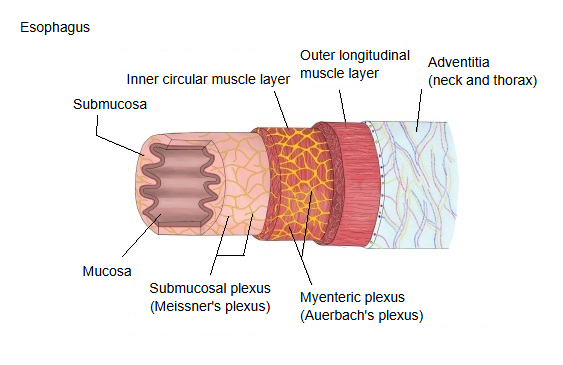
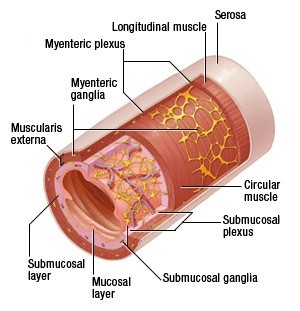
- Myenteric plexus : lies between the inner circular and outer longitudinal muscle layers; mainly regulates peristalsis and the other movements of the gut.
- Submucosal plexus : lies in the submucosa; regulates secretion, the movement of the mucosa and blood flow, and processes sensory information.
The enteric nervous system is often counted as a third division of the autonomic nervous system, alongside the sympathetic and parasympathetic parts; sources differ on this grouping. The extrinsic sympathetic fibres reach it from the prevertebral ganglia (coeliac, superior and inferior mesenteric) through the splanchnic nerves. The submucosal plexus is well developed in the small and large intestine and sparse in the oesophagus.
The figure below shows the nerve supply of the intestinal tract in outline.
supply of
the gut
- Enteric nervous system : the main nerve supply of the gut; works to some degree independently of the central nervous system.
- Myenteric plexus : between the inner circular and outer longitudinal muscle layers = Auerbach's plexus.
- Submucosal plexus : in the submucosa = Meissner's plexus.
- Autonomic nervous system : mainly forms synapses with the enteric nervous system; some fibres act directly on blood vessels and sphincters.
- Sympathetic nerves : (greater, lesser and least thoracic splanchnic nerves, lumbar splanchnic nerves): inhibit peristalsis and secretion; constrict blood vessels and sphincters.
- Parasympathetic nerves : (vagus nerve, pelvic splanchnic nerves): promote peristalsis, secretion and blood flow.
- Sensory nerves : run with the autonomic nerves and are distributed to all layers of the gut.
- Visceral afferents running with the sympathetic nerves : carry pain, ischaemia and inflammation.
- Visceral afferents running with the parasympathetic nerves : carry physiological sensations and reflex input. (Descriptive names, not official terms.)
Functions
· Movements of the intestinal tract: peristalsis, segmentation, tonic contraction, and reflex relaxation and contraction.
· Mucosal function: keeps digestion, absorption and defence working at their best.
The table below compares the work of the two plexuses.
| Item | Myenteric plexus | Submucosal plexus | |
|---|---|---|---|
| 1 | Main position | Between the inner circular and outer longitudinal muscle layers | Submucosa |
| 2 | Main role | Control of movement (moving the gut) | Control of the local environment (secretion, absorption, blood flow) |
| 3 | Typical functions | Generating peristalsis; controlling the strength and timing of contraction | Regulating the secretion of intestinal juice and mucus |
| 4 | Targets | Smooth muscle (inner circular and outer longitudinal layers) | Epithelial cells (and blood vessels) |
| 5 | Relation to movement | Movements that propel the contents | Fine movements (of the muscularis mucosae) that optimize absorption and secretion |
| 6 | Sensory input | Stretch of the muscle; changes in pressure | Chemical stimuli |
| 7 | Main types of neuron | Excitatory motor neurons; interneurons | Secretomotor neurons |
| 8 | Influence of the extrinsic autonomic nerves | Receives it, but is highly independent | Receives it, but works mainly by local reflexes |
Nerve fibres of the plexuses
Looking at the nerve fibres that make up the two plexuses:
The table lists the kinds of nerve fibres in the two plexuses.
| Kind of nerve fibre | Myenteric plexus | Submucosal plexus | |
|---|---|---|---|
| 1 | Sensory fibres | Sense stretch and pressure | Sense chemical stimuli and osmotic pressure |
| 2 | Interneuron fibres | Link the sequence of contraction and relaxation | Link local reflexes |
| 3 | Motor fibres | Contract and relax the smooth muscle | Regulate the muscularis mucosae |
| 4 | Secretomotor fibres | Almost none | Control the secretion of mucus and intestinal juice |
| 5 | Vasomotor fibres | Few | Control mucosal blood flow |
| 6 | Extrinsic autonomic fibres | Mixed in, with a regulating role | Mixed in, with a regulating role |
Input from outside the gut
Extrinsic inputs (by route)
The enteric nervous system is a highly autonomous nervous system of the gut itself and can work to some degree even when completely cut off from the central nervous system (the brain and spinal cord). It also receives branches from extrinsic nerves, and only when these take part in regulating the movements and secretion of the gut does the intestinal tract work as it should. The extrinsic nerves do not drive the enteric nervous system directly but adjust its activity.
Extrinsic nerves and the enteric nervous system
Together they let the intestinal tract work normally.
The table lists the main extrinsic nerve plexuses.
| Plexus | Main position | Nerves gathered in it | Supplies | |
|---|---|---|---|---|
| 1 | Gastric plexus | Around the stomach (lesser and greater curvatures, around the coeliac trunk) | Vagus nerve (parasympathetic); sympathetic fibres (from the coeliac ganglion); afferent fibres | The ENS of the stomach (myenteric and submucosal plexuses) |
| 2 | Superior mesenteric plexus | Around the superior mesenteric artery | Sympathetic fibres (superior mesenteric ganglion); parasympathetic fibres (vagus nerve); afferent fibres | The ENS of the small intestine, caecum, ascending colon and proximal transverse colon |
| 3 | Inferior mesenteric plexus | Around the inferior mesenteric artery | Sympathetic fibres (inferior mesenteric ganglion); parasympathetic fibres (from the pelvic splanchnic nerves); afferent fibres | The ENS of the descending colon, sigmoid colon and upper rectum |
| 4 | Hypogastric plexuses (superior and inferior) | From the bifurcation of the aorta down into the pelvis | Sympathetic fibres (lumbar splanchnic nerves); parasympathetic fibres (pelvic splanchnic nerves, joining the inferior plexus); afferent fibres | The ENS of the rectum and around the anal canal |
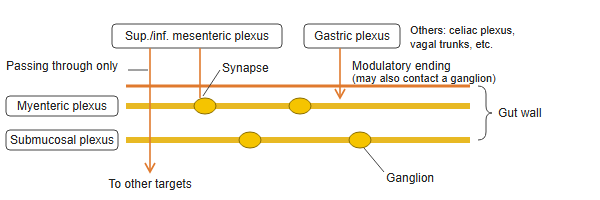
How extrinsic fibres act on the enteric nervous system
| Type | Behaviour | Main kinds of fibre | Main features and roles | |
|---|---|---|---|---|
| 1 | Passing fibres | Only pass through the ENS | Visceral afferent (sensory) fibres; some sympathetic and parasympathetic fibres | Use the ENS as a route; mainly carry information to the centre; often form no clear synapses with enteric neurons |
| 2 | Synapse-forming fibres | Synapse with enteric neurons | Parasympathetic fibres (vagus nerve, pelvic splanchnic nerves); some sympathetic fibres | Give input to the ganglion cells of the ENS; promote or inhibit movement and secretion, but regulate rather than command |
| 3 | Modulatory endings (atypical synapses) | Act without forming clear synapses | Mostly sympathetic fibres | Release neurotransmitters from varicosities (volume transmission); change the excitability of the whole ENS circuit |
| 4 | Fibres going straight to effectors | Reach the target without the ENS | Sympathetic fibres | Act directly on vascular smooth muscle, sphincters and others; the ENS takes little or no part |
| 5 | Mixed (passing + acting) | Act in part and pass in part | Parasympathetic and sympathetic fibres | Branch on their way; regulate the ENS and also project to other layers (such as the submucosal plexus) |
Websites with illustrations
· Website with illustrations and photographs I

· Website with illustrations and photographs II

· Website with illustrations and photographs III
Related terms
- Myenteric plexus
- Submucosal plexus
- Autonomic nervous system
- Submucosa
- Smooth muscle
- Vagus nerve
- Esophagus
References and sources
- Further reading: Enteric nervous system, Wikipedia.
- Further reading: Myenteric plexus, Wikipedia.
- Federative International Programme for Anatomical Terminology (FIPAT). Terminologia Anatomica, 2nd ed. (TA2), 2019.