Body fluid
Also called the total body water
Body fluid is the fluid present in the body; it is of two kinds: the fluid inside cells and the fluid outside cells.
Note: some texts do not count the intracellular fluid, the fluid inside the cells, as body fluid and use the term only for the extracellular fluid.
· Fluids secreted out of the body, such as sweat and tears, are sometimes included in body fluids in a broad sense, but they are special fluids that are not counted as part of the circulating extracellular fluid (ECF).
Examples of fluids passed or secreted out of the body: digestive juices (saliva, gastric juice, bile and others), sweat, tears, urine, semen and others.
Water
in the
body
in the
body
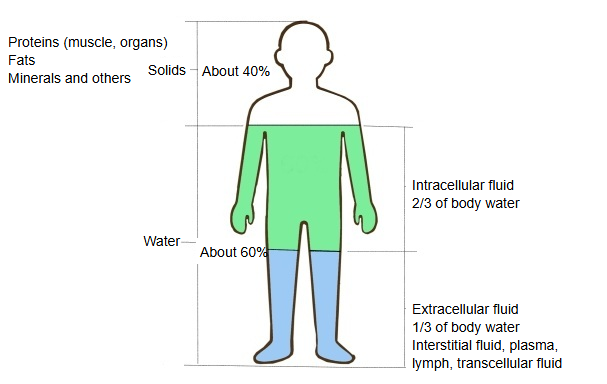
- Intracellular fluid : the fluid inside the cells; about 2/3 of body water, roughly 40% of body weight. Some texts do not count it as body fluid.
- Extracellular fluid : about 1/3 of body water, roughly 20% of body weight.
- Interstitial fluid : about 70–75% of the extracellular fluid; around the cells (between cells, and between cells and capillaries).
- Plasma : about 20–25%; the liquid part of the blood left when the blood cells (red and white blood cells and others) are removed.
- Lymph : about 1–2%; part of the interstitial fluid that has entered the lymphatic vessels.
- Transcellular fluid : about 1–2%; special fluids enclosed by epithelial cells, such as the cerebrospinal fluid and the synovial fluid. Sometimes not counted as extracellular fluid.
- Note : all the water in the body = body fluid, about 60% of body weight (adult).
The proportion of body fluid in body weight is highest in newborns (about 78%) and decreases with age.
From about 4 years of age the same as in adults (about 60%); in older adults it falls to about 50%
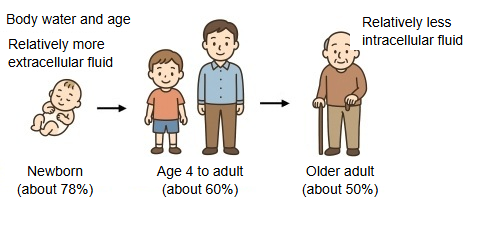
Changes in the proportions of intracellular and extracellular fluid with age
| Age | Intracellular fluid | Extracellular fluid | Comment | |
| 1 | Newborn | Less (relatively) | More (relatively) | Newborns have a large body surface area for their size and tend to have more extracellular fluid. Water is about 75–78% of body weight. |
| 2 | Adult | Standard | Standard | Water is about 60% of body weight; ICF and ECF are roughly 2 : 1. |
| 3 | Older adult | Decreased | Relatively increased proportion | Intracellular fluid decreases mainly because muscle mass is lost: muscle holds much water, so less muscle means less ICF. Water falls to about 50% of body weight. |
Related terms
References and sources
- Further reading: Body fluid, Wikipedia.
- Further reading: Fluid compartments, Wikipedia.
- Federative International Programme for Anatomical Terminology (FIPAT). Terminologia Anatomica, 2nd ed. (TA2), 2019.