Stratum lucidum (Latin: stratum lucidum epidermidis)
Also called the clear layer
of the
epidermis
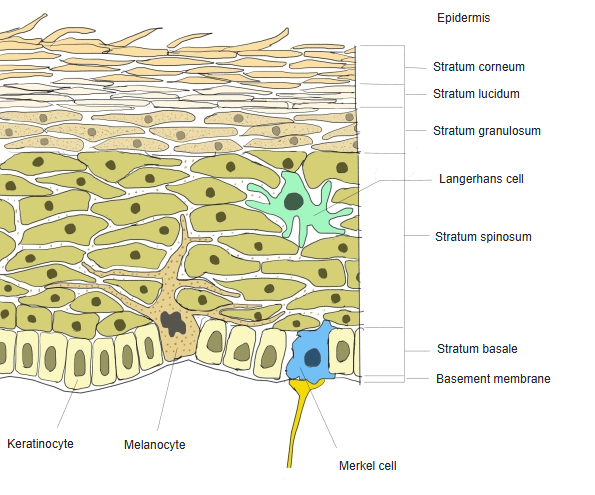
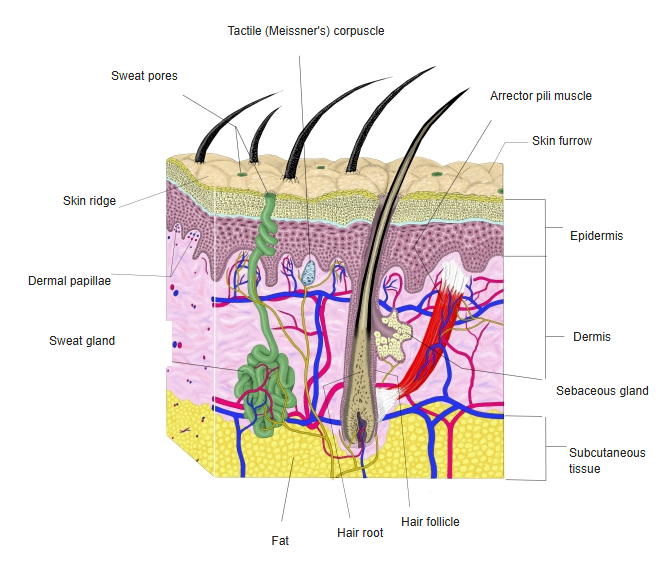
- Stratum corneum : the outermost layer, made of dead keratinocytes; the surface (stratum disjunctum) is constantly shed (desquamation).
- Stratum lucidum : a clear, bright layer at the bottom of the stratum corneum, seen only in thick skin (fingertips, palms, soles); its cells have no nuclei.
- Stratum granulosum : 2–3 rows of many-sided cells with keratohyalin granules in their cytoplasm; the nuclei begin to break down.
- Stratum spinosum : stacked rows of many-sided keratinocytes; the thickest layer in most skin; the cells are joined by intercellular bridges.
- Stratum basale : a single layer of columnar basal cells (keratinocytes); also melanocytes and Merkel cells.
· It is made of stacked, keratinized cells without nuclei that hardly take up stains, so under the light microscope it looks pale and glassy; this gives the layer its name.
· The cells contain eleidin, a substance thought to be a precursor of keratin: a stage between the keratohyalin of the stratum granulosum and the keratin of the stratum corneum.
· It consists of a few rows (about 3 to 6; sources differ) of clear, flattened, dead keratinocytes, which contain much keratin and have a thickened plasma membrane; their outlines are hard to see.
· Desmosomes are still present between neighbouring cells, and the cells are surrounded by lipids released from lamellar bodies in the deeper layers, which help make the skin waterproof. In thin skin the layer is absent or not distinct, and the stratum granulosum is followed directly by the stratum corneum. Some authors count it as the deepest part of the stratum corneum.
Reference websites
[Wikipedia]
· Stratum lucidum, Wikipedia.
· Epidermis, Wikipedia.
Related terms
- Stratum granulosum
- Stratum corneum
- Keratinocyte
- Keratohyalin granule
- Epidermis
- Palm of hand
- Sole of foot
References and sources
- Further reading: Stratum lucidum, Wikipedia.
- Further reading: Epidermis, Wikipedia.
- Federative International Programme for Anatomical Terminology (FIPAT). Terminologia Anatomica, 2nd ed. (TA2), 2019.