Merkel cell (Latin: epitheliocytus tactus)
Also called Tactile epithelial cell or Merkel–Ranvier cell
cells of the
epidermis
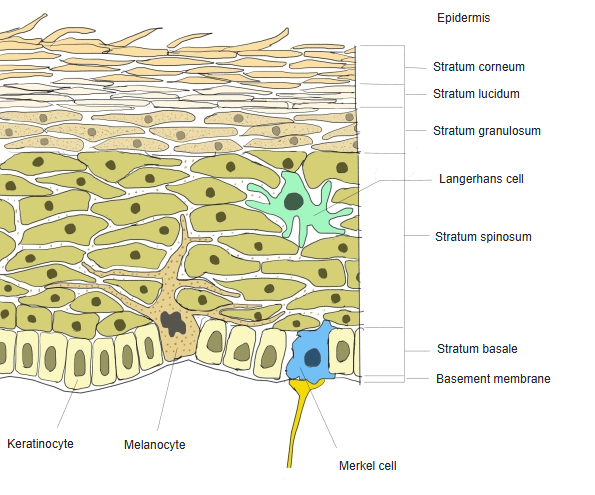
- Keratinocytes : about 90% of the cells. They divide actively and some move up into the upper layers; also called keratinising cells.
- Melanocytes : lie in the stratum basale and produce melanin (pigment).
- Merkel cells : many in highly sensitive areas such as the fingertips; connected to afferent (sensory) nerve fibres.
- Langerhans cells : dendritic cells of the immune system in the stratum spinosum; about 2–5%.
· A pale, clear cell found in the stratum basale of the epidermis, about 10 µm across. It sits among the basal keratinocytes, joined to them by desmosomes, and has a lobed nucleus and small dense-cored granules in its cytoplasm.
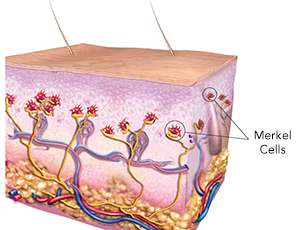
· Together with its nerve ending it forms an oval mechanoreceptor for light touch. This receptor adapts slowly: it signals sustained light pressure and helps us sense shape, edges and texture. Merkel cells are most numerous where touch is fine, such as the fingertips, the lips and the bases of hair follicles.
· The flattened ending of a myelinated afferent (somatosensory) nerve fibre, the Merkel disc, lies against the base of each cell and forms synapse-like contacts with it; together they form the Merkel cell–neurite complex.
Reference websites
[Wikipedia]
· Merkel cell, Wikipedia.
[Websites with illustrations]
· Layers of the epidermis, with the cell types (figure) (Wikimedia Commons)

· Merkel cells in the epidermis (figure) (Skin Cancer Foundation)
Related terms
References and sources
- Further reading: Merkel cell, Wikipedia.
- Federative International Programme for Anatomical Terminology (FIPAT). Terminologia Anatomica, 2nd ed. (TA2), 2019.