Pyramidal cell
Also called the pyramidal neuron
· The two cells have different English names (pyramidal cell in the cerebrum, cone cell in the retina), and pictures of them show that their shapes are also very different.
Pyramidal cells of the cerebrum
Cerebrum: pyramidal cell (pyramidal neuron). The excitatory neurons of the cerebral cortex, the hippocampus and the amygdala whose axons project to distant areas (projection neurons).
They make up most of the neurons of the cerebral cortex, often given as about two-thirds to 80%; sources differ.
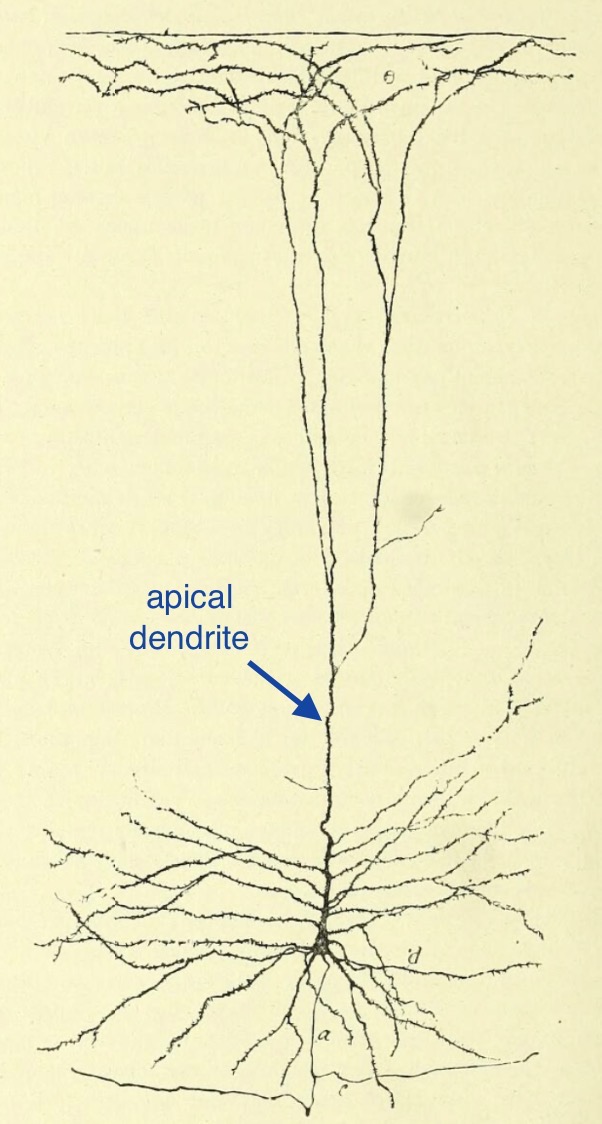
· The apex of the cell body points towards the surface of the cortex and gives off one long apical dendrite; several basal dendrites spread out from the base. The dendrites are covered with small spines that receive synapses.
· A single axon leaves the base of the cell body and heads into the white matter, running to other parts of the cortex, to the opposite hemisphere, or down to the brainstem and spinal cord. The largest pyramidal cells, the giant (Betz) cells of the primary motor cortex, send their axons into the corticospinal tract.
· They use glutamate as their transmitter. The smaller, mostly inhibitory neurons that link them locally are interneurons.
· Cajal's drawing of a pyramidal cell with its apical dendrite (Southern Illinois University)
· Pyramidal neurons from different layers of the cortex and the hippocampus (Nature Reviews Neuroscience)
Cone cells of the retina
Retina: cone cell. One of the photoreceptor cells; cone cells are concentrated in the centre of the retina and lie in its outermost layer of neurons.
receptor
cells
- Rod cell : rod-shaped outer segment; most of the photoreceptors; receive light in dim light.
- Cone cell : cone-shaped outer segment; concentrated in the centre of the retina; give sharp vision and colour vision in bright light.
optic part
of the retina
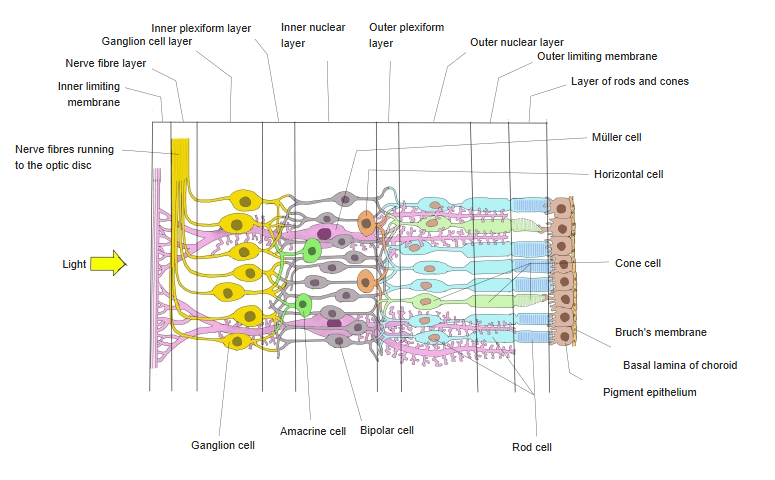
- Rod cell : photoreceptor; rod-shaped outer segment; most of the photoreceptors; receives light in dim light.
- Cone cell : photoreceptor; cone-shaped outer segment; concentrated in the centre of the retina; colour vision and sharp vision in bright light.
- Horizontal cell : its processes spread horizontally in the retina and form synapses with photoreceptor cells.
- Bipolar cell : has two processes, one above and one below the cell body; passes signals from the photoreceptors to the ganglion cells.
- Amacrine cell : a local interneuron without a long axon; links bipolar cells and ganglion cells.
- Ganglion cell : has a long axon that runs to the brain; the axons form the optic nerve, the optic chiasm and the optic tract.
- Müller cell (supporting cell) : a glial cell, not a neuron; it supports the retina and does not pass on signals.
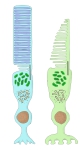 Rod and cone cells
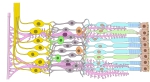 Layers of the retina
- Layers of the retina
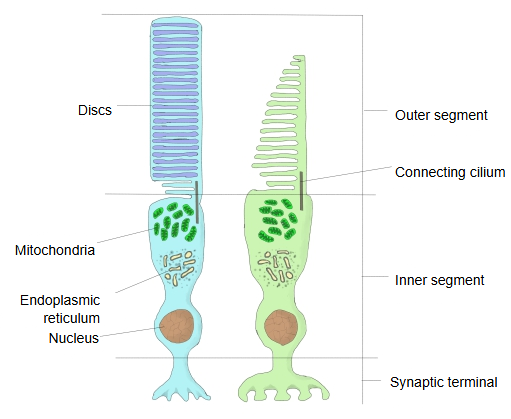

· Cone cell (labelled diagram) (Wikimedia Commons)

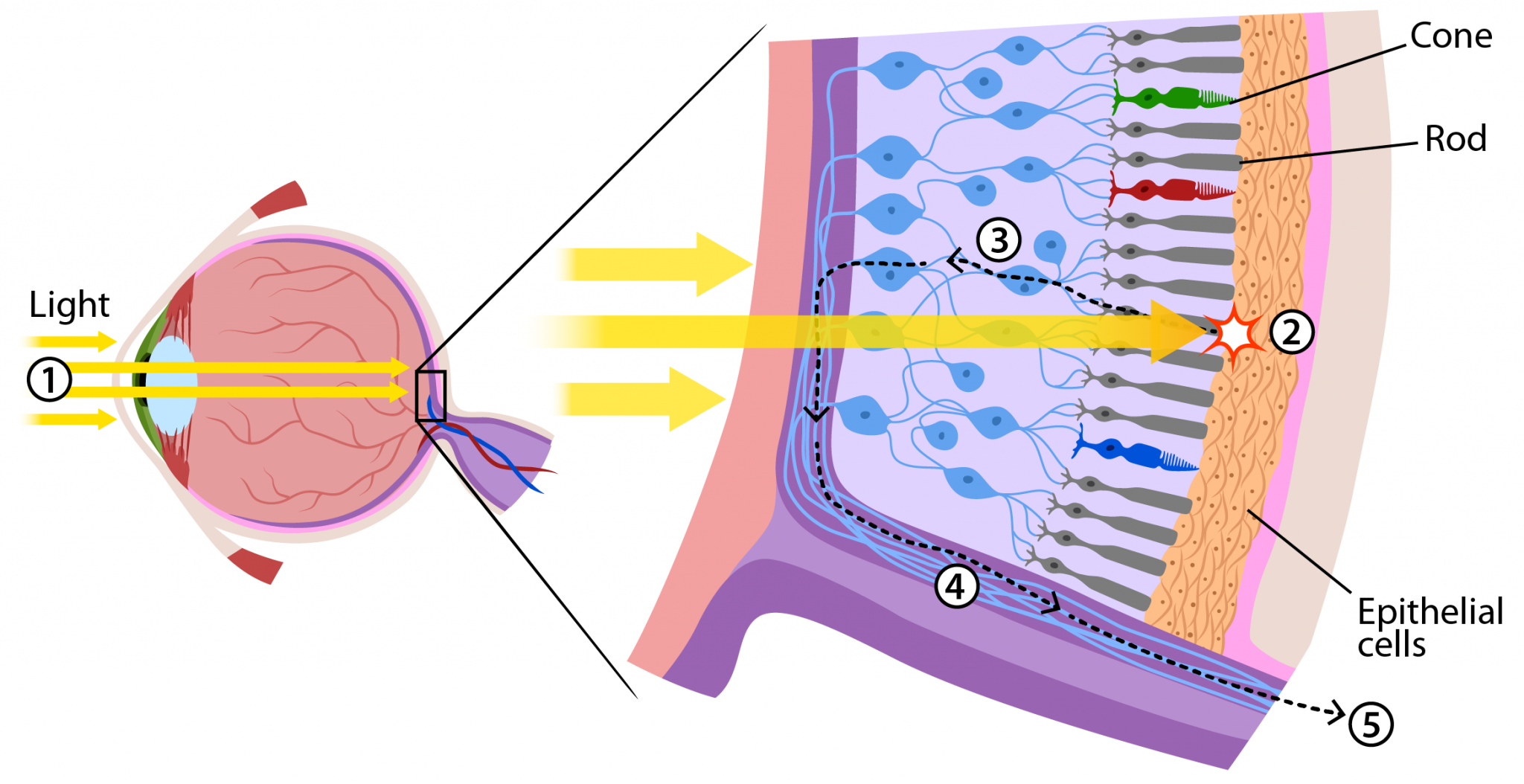
· Light passing through the eye to the rods and cones of the retina (Ask A Biologist, Arizona State University)
Related terms
References and sources
- Further reading: Pyramidal cell, Wikipedia.
- Federative International Programme for Anatomical Terminology (FIPAT). Terminologia Anatomica, 2nd ed. (TA2), 2019.