Actin filament
Also called the microfilament or F-actin
= Microfilament (also called F-actin).
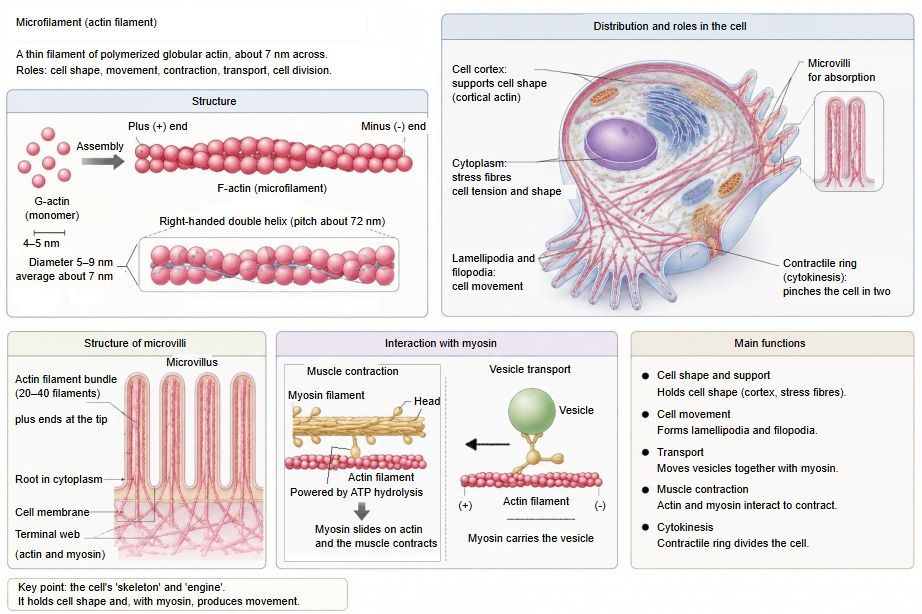
The actin filament is the thinnest protein filament of the cytoskeleton, about 7 nm across, built from the protein actin.
Globular actin molecules (G-actin) join into a filament (F-actin) made of two strands twisted round each other in a helix. The filament has a fast-growing plus end and a slower minus end. Its quoted diameter varies (about 5–9 nm); sources differ.
Just under the plasma membrane a dense actin network (the cell cortex) holds the shape of the cell; bundles in the cytoplasm (stress fibres) resist tension, and bundles of actin form the core of microvilli.
Together with the motor protein myosin, actin filaments make cells crawl (lamellipodia and filopodia), carry vesicles, and pinch a dividing cell in two (the contractile ring).
In muscle cells they are the thin filaments of the myofibrils; their sliding along the myosin filaments of each sarcomere causes contraction. With the microtubules and intermediate filaments they make up the cytoskeleton.
 Microfilament (overview)
Related terms
References and sources
- Further reading: Microfilament, Wikipedia.
- Further reading: Actin, Wikipedia.
- Federative International Programme for Anatomical Terminology (FIPAT). Terminologia Anatomica, 2nd ed. (TA2), 2019.