Goblet cell (Latin: exocrinocytus caliciformis)
- Overview
- Secretion
- Proportion by region
- Reference websites
- (Wikipedia, websites with illustrations)
- Related terms
Overview
It is a unicellular exocrine gland. Its wide upper part is packed with secretory vesicles of mucin; its narrow base holds the nucleus, rough endoplasmic reticulum and Golgi apparatus. Short microvilli cover the free surface.
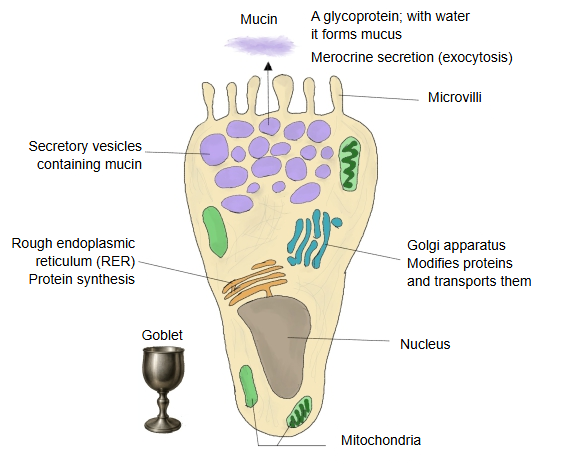
cells
- Exocrine cells : cells that form part of the exocrine glands and release substances outside the body or into a body cavity (the digestive tract and others). Most form acini and carry their secretion through ducts; an exception is the goblet cell.
- Secretions : serous fluid (pancreas, parotid gland), mucus (sublingual gland, goblet cells of the airways) or a mixture of both (submandibular gland).
- Outside the body : sweat glands, sebaceous glands, mammary glands, lacrimal glands.
- Into body cavities : salivary glands, gastric glands, acinar cells of the pancreas, goblet cells of the intestine.
- Endocrine cells : have no duct and release their secretion directly into the surrounding capillaries, lymphatic vessels and tissue fluid.
- Secretions : almost all are hormones (insulin, adrenaline and others); a few are hormone-like substances.
- Solitary endocrine cells : scattered in the digestive tract, e.g. G cells and I cells (enteroendocrine cells).
- Clustered endocrine cells : form glands: the adrenal cortex, the pituitary gland, the thyroid gland.
The diagram below classifies exocrine cells by whether they have a duct and an acinus.
cells
- Duct present
- Acinus present : most exocrine cells form acini and secrete through ducts. Exocrine cells packed together like a bunch of grapes form an acinus, and they are then called acinar cells.
- No acinus : e.g. the epithelial cells of the intercalated and striated ducts of the salivary glands and the pancreas.
- No duct : goblet cells: secrete mucin (the glycoprotein that forms mucus) by merocrine secretion; found in the digestive tract (large and small intestine) and the airways (trachea, bronchi). The surface mucous cells of the stomach also secrete without a duct.
Secretion
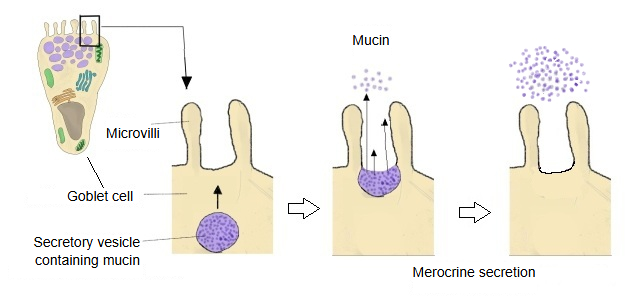
Under strong stimulation the whole store of mucin may be released at once; some sources describe this as apocrine-like release.
The table below summarises the ways in which exocrine cells secrete.
| Mode of secretion | Description | Examples | |
|---|---|---|---|
| 1 | Merocrine secretion = exocytosis | Only the secretion is released, in vesicles; the cell itself is not damaged. | Pancreatic acinar cells, salivary glands (parotid gland and others), goblet cells |
| 2 | Apocrine secretion | Part of the cell (apical cytoplasm and membrane) is pinched off with the secretion. | Mammary glands, apocrine sweat glands of the axilla |
| 3 | Holocrine secretion | The whole cell breaks down and becomes the secretion. | Sebaceous glands |
Proportion by region
The share of goblet cells among the epithelial cells differs by region (rough figures; sources differ):
| Region | Share of the epithelial cells | Remarks | |
|---|---|---|---|
| 1 | Small intestine (especially jejunum and ileum) | about 10–25% | Scattered among the absorptive cells of the villi and crypts; the number increases towards the ileum |
| 2 | Large intestine (colon and rectum) | about 30–40% (or more) | Even higher in the rectum; much mucus is needed for the passage of faeces |
| 3 | Airways (epithelium of the trachea, bronchi and others) | about 10–20% | Scattered in the pseudostratified ciliated epithelium; the mucus traps inhaled particles |
Goblet cells are also found in the conjunctiva of the eye. Sources differ on the exact proportion of goblet cells in each region.
Reference websites
[Wikipedia]
· Goblet cell, Wikipedia.
[Websites with illustrations]
· Goblet cell (illustration) (Wikimedia Commons)

· Respiratory mucosa with goblet cells (micrograph) (GetBodySmart)

· The role of goblet cells and mucus in intestinal homeostasis (Nature Reviews Gastroenterology & Hepatology)
Related terms
- Mucus
- Exocrine gland
- Villi
- Intestinal epithelial cells
- Paneth cell
- Enteroendocrine cell
- Small intestine
References and sources
- Further reading: Goblet cell, Wikipedia.
- Federative International Programme for Anatomical Terminology (FIPAT). Terminologia Anatomica, 2nd ed. (TA2), 2019.